Scientists have created a "baby" wormhole using the Google Sycamore 2 quantum computer.
The new study is the first step toward exploring quantum gravity in the lab.When scientists saw the data, they had a "panic attack," so impressive is it And here's why.
How to create a "quantum wormhole"?
Wormholes, or wormholes, are hypothetical tunnels in space-time connected by black holes (black holes ) at either end.In nature, their immense gravity provides the conditions for a wormhole to appear, but the one simulated in the new experiment is slightly different.It's essentially a "toy" model based on quantum teleportation that simulates two black holes to send information through a portal.
Gravity and the quantum world are historically consideredopposite, different processes. But, according to researchers, this is not entirely true. According to the holographic principle, a theory of gravity that does not work around black hole singularities can be explained by quantum laws. Thus, the new experiment, among other things, changes physics, linking the general theory of relativity (GR) and quantum mechanics.
Einstein's predictions
The idea of wormholes was first proposed by AlbertEinstein and his colleague Nathan Rosen in 1935. Then they suggested that, within the framework of general relativity, black holes can be connected by bridges that work like a “portal.” This theory is an attempt to offer an alternative explanation for singularity points in space—the cores of black holes. There, the mass will endlessly concentrate at one point, creating such a powerful gravitational field that space-time is distorted to infinity, destroying Einstein's equations. However, if this “behavior” of black holes leads to the formation of wormholes, then general relativity is correct, scientists reasoned.
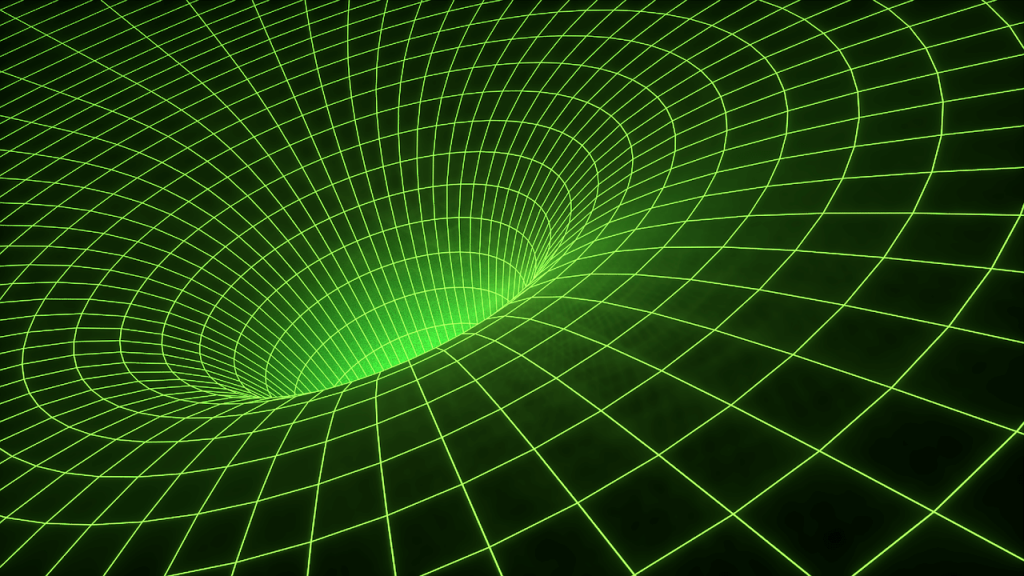 A wormhole that distorts space-time. Source: Needpix.com
At the same time, a month before publicationfamous 1935 paper, Einstein, Rosen and their colleague Boris Podolsky conducted another study. Then they made a prediction that differed from their later work on general relativity. It did not support quantum theory, but rather discredited its “ridiculous conclusions.”
If the rules of quantum mechanics are true, the propertiestwo particles must be inextricably linked, scientists emphasized. Measuring one would instantly affect the other, even if they are separated by a huge distance. Einstein ridiculed this process, and today it is known as quantum entanglement. The scientist called it “ghostly action at a distance,” hinting at its unreality. However, since then it has been observed and used more than once by physicists.
The main mistake of a scientist
Even though Einstein did these twogroundbreaking predictions, his distaste for quantum physics' uncertainty and strangeness blinded him. As a result, he did not make a vital discovery: general relativity and quantum physics may be related, as are his two assumptions. By separating general relativity from quantum theory, physicists have not explored an important area of science in which gravity and quantum effects collide. As a result, we still do not know what is hidden inside black holes and the infinitesimal point in which the Universe was concentrated at the moment of the Big Bang.
Holographic principle
Since Einstein reached a dead end,Scientists tried to create a “theory of everything” - to combine relativity and the quantum world. In the process, physicists created many very unusual theories, one of them is the holographic principle. According to it, the Universe is a three-dimensional holographic projection of processes that occur on a remote two-dimensional surface.
The idea originated in the work of Stephen Hawking in the 1970syears. He then formulated an apparent paradox: if black holes actually emit Hawking radiation (virtual particles that appear randomly near the event horizon), they will eventually evaporate. This violates the fundamental rule of quantum mechanics that information cannot be destroyed. Now GR and quantum mechanics no longer just seemed irreconcilable; Despite many incredibly accurate predictions, they could be completely wrong.
To solve this problem, proponents of the theorystrings, which reconciled the quantum world and general relativity, postulated that the information in a black hole is connected to the two-dimensional surface of its event horizon (the point beyond which even light cannot escape due to supergravity). Physicists believed that information about a star collapsing into a black hole was woven into fluctuations on the surface of that horizon before being encoded in Hawking radiation and sent before the black hole evaporated.
In the 1990s, theoretical physicists LeonardSusskind and Gerard Hoeft realized that this idea needed to be developed (in honor of Susskind, one of the heroes of the sitcom “The Big Bang Theory” was destroyed). If you imagine all the information about a three-dimensional star on a two-dimensional event horizon, then the Universe (which also has its own expanding horizon) is also a three-dimensional projection of two-dimensional information - a hologram.
 An artist's idea of an information portal. Photo: Needpix.com
From this point of view, two disparate theories - onin fact, a unified whole. The gravitational curvature of space-time, like everything else we see, is a holographic projection. It appeared as a result of the smallest interactions of quantum particles on the low-dimensional surface of a distant horizon.
Idea validation
To test these ideas, physicists usedGoogle computer Sycamore 2. They loaded it with a basic model of a simple holographic universe that contained two quantum entangled black holes at each end. After encoding the input message into the first qubit, the scientists watched as it turned into gibberish (as if it had been swallowed by the first hole). And then, it flew out unencrypted and undamaged at the other end, as if it had been “spit out” by the second black hole.
What's next?
The most amazing thing about the wormhole experimentis not that the message has passed in one form or another. It is important that it appeared completely intact. In fact, the model behaved like a physical wormhole: the experiment showed that it could be powered by quantum entanglement.
At the same time, the information passed through a tinygap It was only a few times larger than the shortest conceivable distance in nature—the Planck length. In the future, scientists will develop more complex experiments and perform them with more advanced equipment. The goal is to send messages over long distances.
What's the bottom line?
Analogues of a black hole in the quantumcomputers are not all-consuming monsters hiding in space. Scientists aren't sure if they've modeled black holes accurately enough, and they've called these quantum computer fractures "emergent" black holes. However, physicists noted that they "look like ducks, walk like ducks, and quack like ducks." It looks like they really are ducks.
A large-scale theoretical “leap” from theIt is not necessary to send something physical, such as a subatomic particle, through a wormhole instead of information. However, physicists emphasize that creating a true mini-black hole would require a much higher density of qubits. It is very difficult to do this experimentally. There is still a lot of work to be done before sending the dog Laika into a wormhole, as he once did into space.
Read more:
The egg was dropped from space: look what happened to it
Brain-eating amoeba is spreading in the US: is there a danger to Russia
See what a woman Thora looks like. She lived 800 years ago
On the cover: an artist's idea of a wormhole