Physicists from the University of California at Santa Barbara have improved photon detectors. New method
Researchers have modified microwavekinetic inductance detectors (MKID). These sensors use the photoelectric effect. A photon entering the sensor knocks down an electron, which can then be detected as a signal suitable for processing by a microprocessor, the developers explain.
As a rule, an MCID is a superconductor located on a substrate. The researchers found that some of the electrons from the sensor "leaked" into the sapphire substrate, reducing measurement accuracy.
In their work, the researchers showed that thinA layer of indium metal placed between the superconducting sensor and the substrate dramatically reduces energy leakage, increasing the resolution of the photon detector.
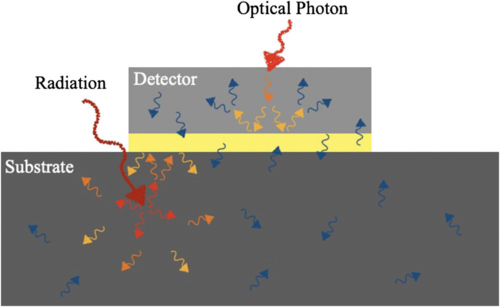 Device diagram. The yellow layer of indium blocks photons, but does not prevent the free movement of lower energy phonons. Source: Nicholas Zobrist et al, Physical Review Letters
Physicists have tested a new device andfound that the new method reduced the error in measuring the wavelength of light from 10% to 5%. For example, with this system it is now possible to measure photons with a wavelength of 1000 nm with an accuracy of 50 nm.
The developers believe that the new sensors will helplook inside exoplanets. Currently, scientists can only perform spectroscopy on a tiny subset of these objects. The planet must pass between its star and the Earth, and it must have a dense atmosphere in order for enough light to pass through it for the work of researchers. And even in such conditions, the ratio of information and noise is very high. Scientists believe that sensors with high spectral resolution will solve this problem.
Cover image: Ben Mazin, UC Santa Barbara
Read more:
A black hole in the galaxy proved Einstein right. The main thing
"James Webb" will show space before the Big Bang: astronomers on the verge of a global discovery
Look at the celestial "Titanic" that will run on nuclear power