What probe are we talking about?
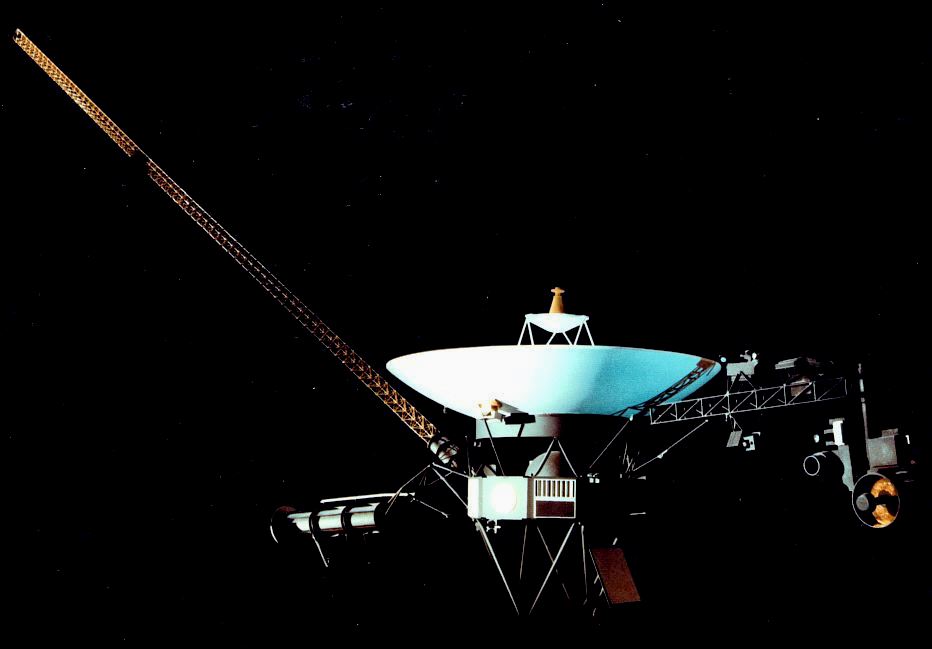
Voyager 2 is an active space probe launched by NASA on August 20, 1977 as part of
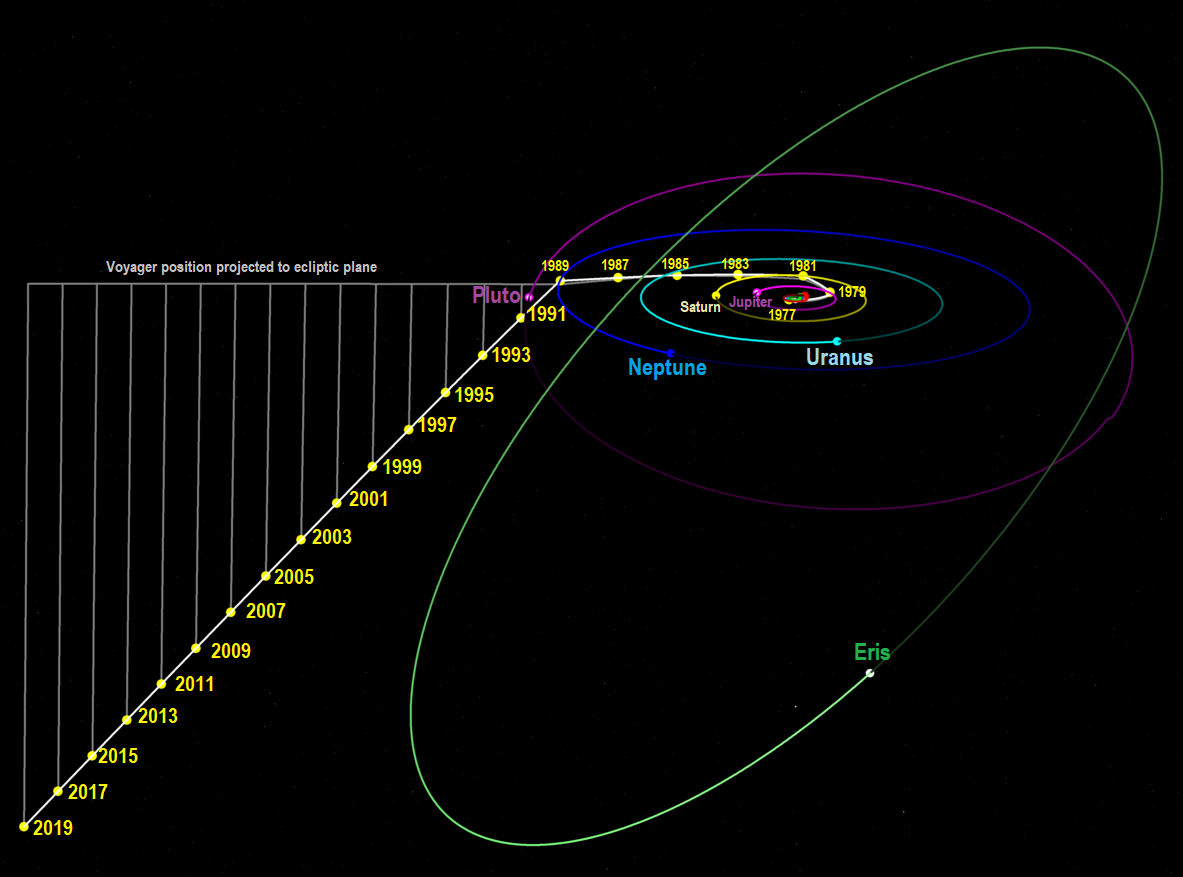
This is the first and only spacecraftreached Uranus (in January 1986) and Neptune (in August 1989). Voyager 2 held the record for the range of a reached and studied object in the solar system for more than 25 years, until it was surpassed by the New Horizons space probe, which reached Pluto in July 2015.
Where did he fly?
Voyager 2 launched on August 20, 1977, that is, 43 years ago.
Voyager 2's mission originally includedstudying only Jupiter and Saturn, as well as their satellites. The flight path also included the possibility of passing Uranus and Neptune, which was successfully implemented. During this time, the device managed to visit:
- July 9, 1979 - the closest approach to Jupiter (71.4 thousand km).
Voyager 2 came close to Europa and Ganymede,Galilean satellites not previously explored by Voyager 1. The transferred images made it possible to put forward a hypothesis about the existence of a liquid ocean under the surface of Europa.
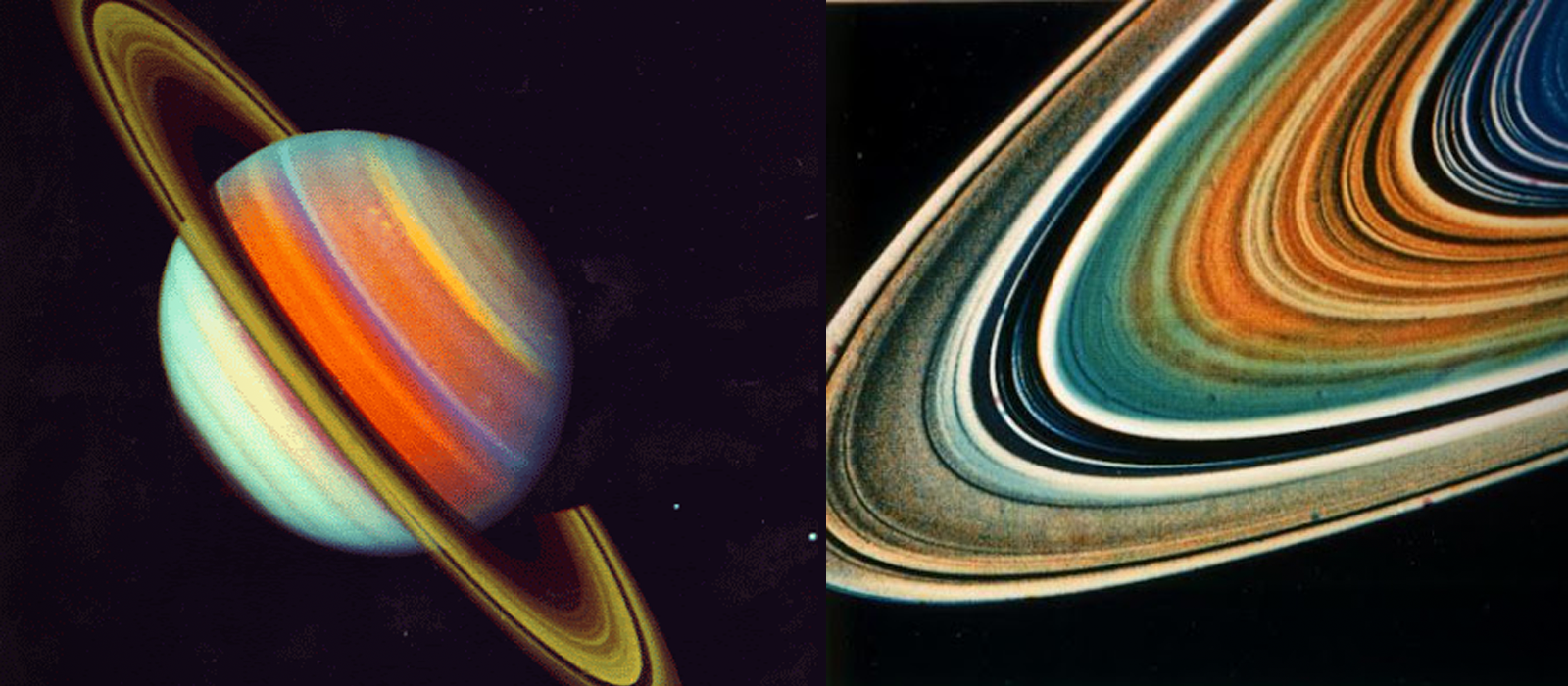
- August 25, 1981 - the closest approach to Saturn (101 thousand km).
- January 24, 1986 - the closest approach to Uranus (81.5 thousand km).
The device transmitted thousands of images of Uranus to Earth,its satellites and rings. Thanks to these photographs, scientists discovered two new rings and examined nine already known ones. In addition, 11 new satellites of Uranus were discovered.
- August 24, 1989 - the device flew 48 thousand km from the surface of Neptune.
Unique images of Neptune and its large satellite Triton were obtained. Active geysers were discovered on Triton, which was very unexpected for a moon far from the Sun and cold.
- On November 4, 2011, the team was sentswitching to a spare set of attitude control engines. After 10 days, we received confirmation of the switch. This will allow the device to work for at least 10 more years.
- On December 10, 2018, NASA confirmed thatVoyager 2 crossed the heliopause and entered interstellar space. The probe remains within the solar system, the gravitational boundary of which is beyond the outer edge. Oort clouds, a collection of small objects under the gravitational influence of the Sun.
- On November 2, 2019, NASA announced its readiness to publish data obtained by the spacecraft in the interstellar medium. November 4, 2019 in the magazineNature astronomyfive articles were published, each of which describesresults from one of the five Voyager 2 instruments - a magnetic field detector, two particle recorders in different energy ranges, and two instruments for studying plasma - a gas consisting of charged particles.
What's with him now?
The second device, Voyager 2, left the limitsthe heliosphere much later, in December 2018. Its entry into the interstellar medium became a noticeably more important event for scientists, because thanks to this, they were able to measure the properties of the interstellar medium using Voyager 2 instruments for the first time.
However, in March of this year, the mission encounteredanother complication: there are only three long-range space communication antennas on Earth that can work with Voyager devices. One of them, DSS43, was turned off last year for a major upgrade. This 70-meter "dish" was turned off in mid-March for repairs and upgrades.
Because of this, scientists could not send commands to Voyager 2, since only DSS43 had enough power to maintain communication with it.
Other antennas installed in Spain andCalifornia, can only receive signals from Voyager 2 due to the peculiarities of the trajectory of its flight and the great distance from the Earth. Scientists could only receive certain information from the spacecraft, but not send control commands.
Due to a large number of failures and problems with equipment, the mission was in jeopardy.
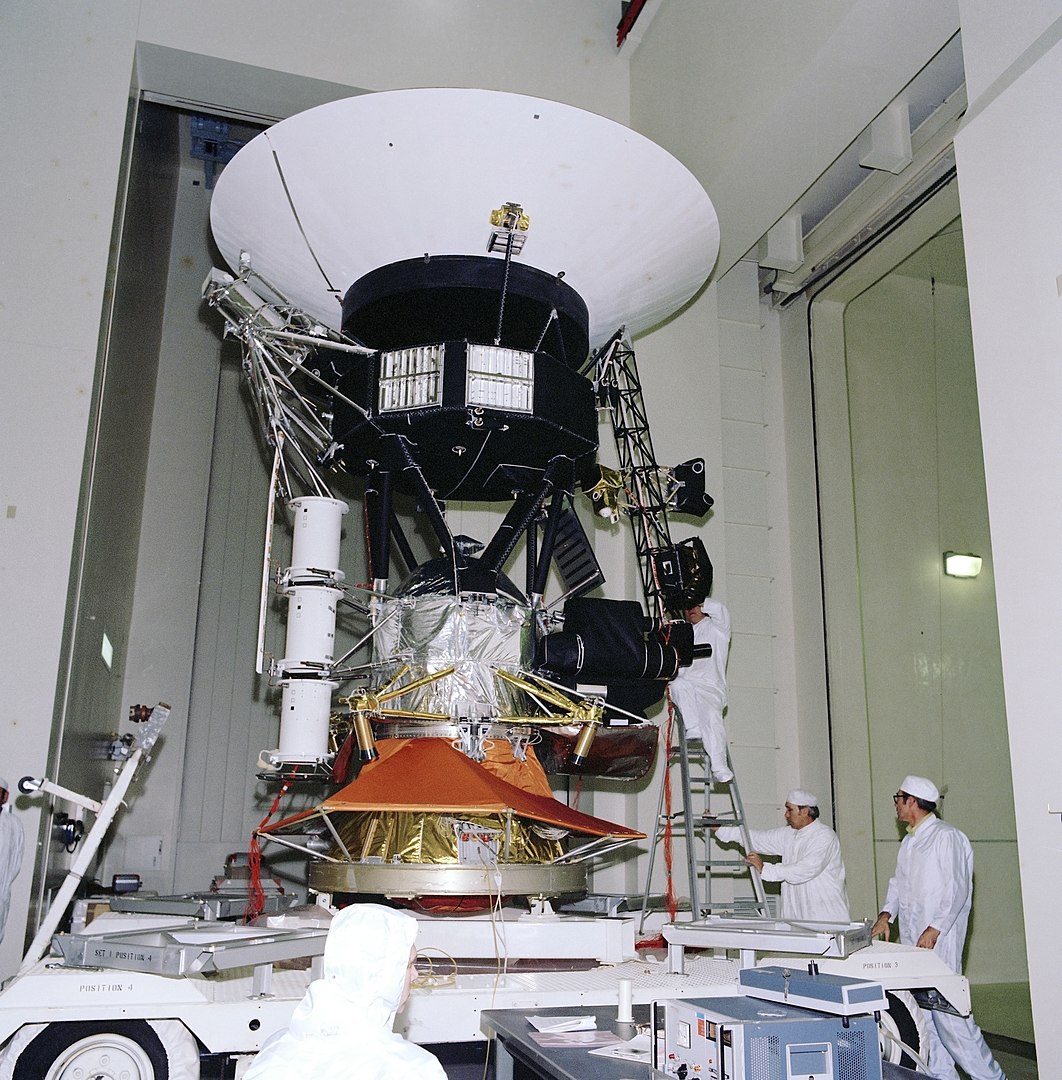
Recently, NASA engineers partially turned on DSS43, after which scientists tried to send a set of commands to Voyager 2.
On October 29, during a test run of the DSS43, the specialists established a connection with the Voyager 2 probe. The device responded to the request and executed the commands received without any problems.
What's the bottom line?
A successful communication session indicates that the device has successfully survived an eight-month flight without any control from a ground control station.
The updated DSS43 system is scheduled to launch in February next year. It is then that the autonomous antenna will be able to continue operating at full power.
Read also
The annual mission in the Arctic has ended and the data are disappointing. What awaits humanity?
Scientists are trying to understand how long a neutron lives. Why is it so difficult and important?
Astronomers have discovered a quasar with the strongest winds