A team of astrophysicists led by Shinji Fujita from the Osaka Metropolitan Graduate School of Science
The researchers used the distribution data inCarbon monoxide in the galaxy, collected by the 45-meter telescope of the Nobeyama Radio Observatory. Using AI, scientists estimated the distance to each of these molecular clouds and determined their size and mass.
As a result, researchers have created the mosta detailed map of the distribution of star-forming regions. So far, their work covers only the first galactic quadrant - one of the four sectors into which the Milky Way is conventionally divided.
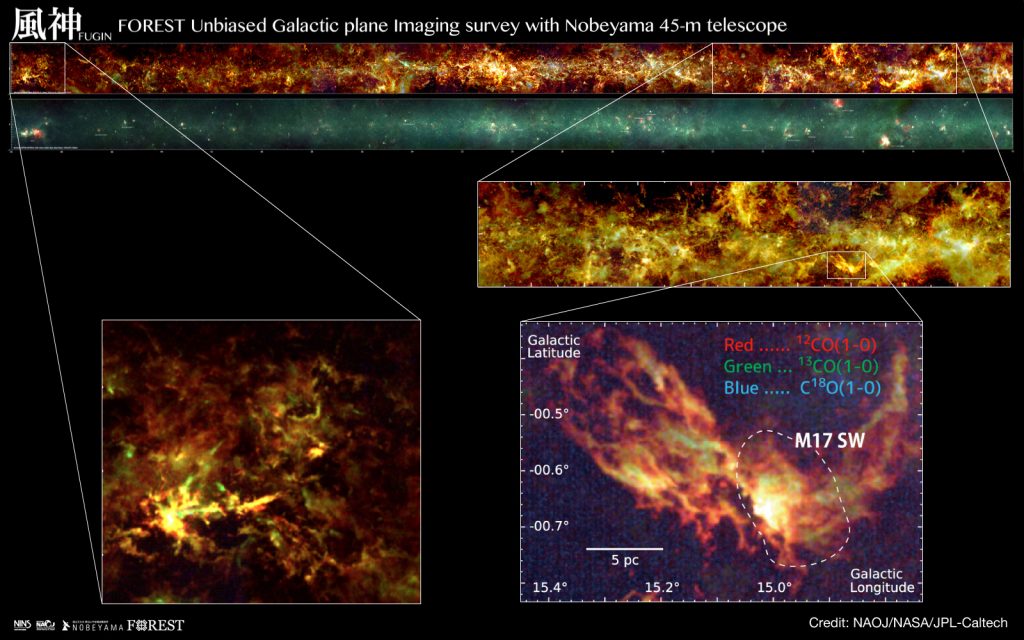 Search results for the Milky Waymolecular clouds (upper thin line) and Spitzer infrared imagery. In the callouts are the results of the analysis of star-forming regions based on carbon monoxide. Image: NAOJ, NASA, JPL-Caltech
Stars are formed from mergersmolecular gas and dust in space. These molecular gases are so rarefied and cold that they are invisible to the human eye, but they emit weak radio waves that can be observed using radio telescopes.
The difficulty lies in the fact that when observingThe Earth has a lot of matter in the background and in front of such areas, and these overlapping features make it difficult to determine their distance and physical properties such as size and mass.
The scientists plan to continue their work, in particular, supplementing their data with observations of the sky in the southern hemisphere to supplement data on other parts of the Milky Way that are not visible in Japan.
Read more:
The mystery of the red stripes on the satellite of Jupiter is revealed
Found "impossible" planet. She defies modern science
Archaeologists have found an ancient Roman analogue of barbed wire