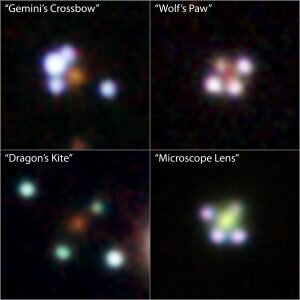
A recent study that took just 1.5 years has increased the number of known quadruples.
The researchers used data from the WISE telescope,and then Gaia to overlay the resulting data. They then used machine learning tools to determine which quasars were quadruples and which were included in the list by mistake.
Follow-up observations using a spectrometerLow-resolution images from the Keck Observatory (LRIS), as well as the Palomar Observatory, New Technology Telescope and Gemini-South confirmed which of the objects were indeed quasars.
The authors study these types of quasars because they can help determine the expansion rate of the Universe and answer questions about dark matter.
New quadruple quasars, which were named,for example, "wolf's paw" and "dragon's snake" will help in future calculations of the Hubble constant. Because of their location, quasars give astronomers the opportunity to explore the intermediate range of the Universe.
The authors respond that they will continue to use and improve AI, but it will not replace human decision makers.
Read more
The first accurate map of the world was created. What's wrong with everyone else?
Scientists explain the appearance of "spiders" on the surface of Mars
Researchers plunged for the first time to the deepest sunken ship