The company is building hydrogen jet airliners with full hydrogen propulsion.
Working with ArianeGroup, a joint ventureAirbus-Safran, Airbus has completed testing of a complete hydrogen supply system for an aircraft gas turbine engine as part of the HyPERION project. It is a French abbreviation that stands for "hydrogen for an environmentally responsible aircraft engine". System development began in December 2020. The main goal is to produce practical hydrogen commercial airliners by 2035. Both technologies must operate with a high degree of security.
In this case, the idea is tocombine Airbus' experience in aircraft manufacturing with ArianeGroup's liquid hydrogen systems developed for the Ariane family of space rockets. In the new system, hydrogen is stored as a supercooled liquid in cryogenic tanks. The fuel system itself preheats the liquid, converting it back into gas, which is fed to the engines at the optimum temperature and pressure.
ArianeGroup test center in Vernon conductedtests with the French aerospace laboratory ONERA. Engineers used an electric pump, gas generator and heat exchangers originally developed for Ariane rockets.
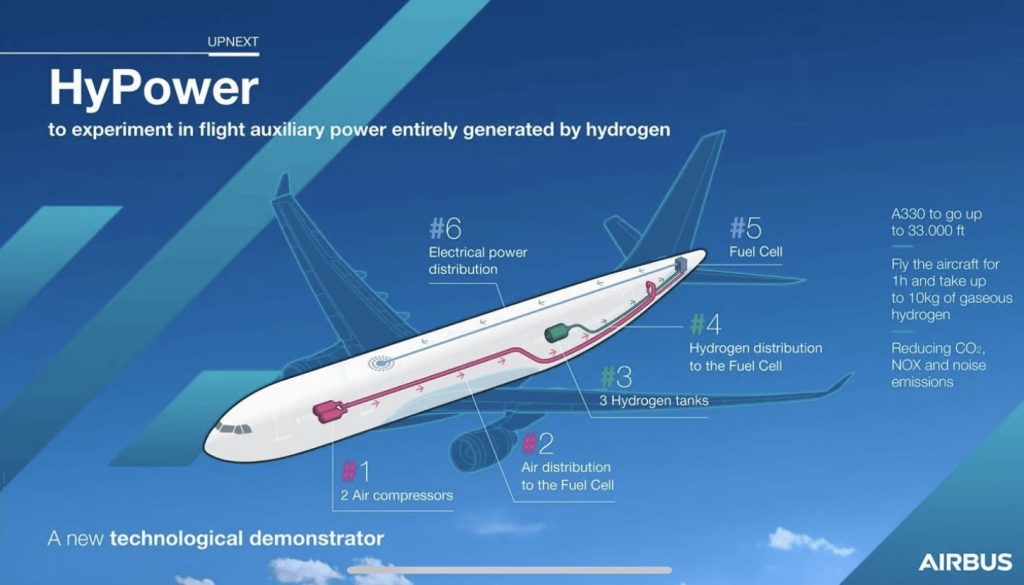 HyPower infographic. Photo: Airbus
In another Airbus project, UpNext, is working ondemonstration project to replace the "hidden" engine on airliners (it is located in the tail of the aircraft). This is an APU, which is a jet turbine engine connected to a generator to provide electricity to the onboard lighting, galley and cockpit avionics.
Airbus wants to build a technologicala demonstrator called HyPower by 2025 that will replace the APU on the Airbus A330 with a hydrogen fuel cell that will reduce the conventional unit's emissions and noise levels.
Read more:
A quasi-moon was found near the Earth: it has been traveling with our planet for more than 2,000 years
Researchers have shown what Pharaoh Tutankhamun looked like
Physicists first took x-rays of a single atom