The situation with US sanctions, which Huawei came under last year (no, it’s not over)
E - ecosystem
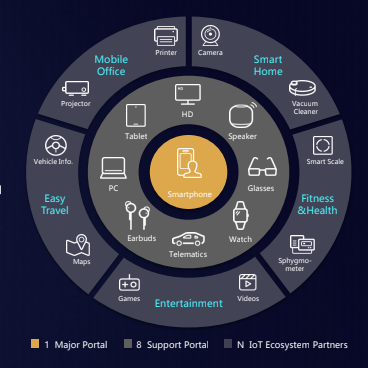
As we have already written, the HMS development strategycalled “1+8+N”, where a smartphone user will live surrounded by an ecosystem of eight types of devices, and an unlimited (in the future, while the number of available to users is small) number of IoT services.
</ img>
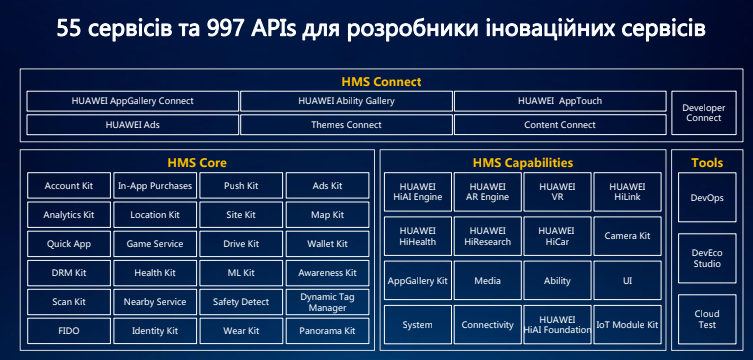
From the user's point of view, he will needInstead of a Google account, use (create if you don’t have one) a Huawei account to access HMS services and the AppGallery application store. But it’s worth remembering that the range of Huawei mobile services is not limited to the application store and system libraries for individual functions. There is also a cloud storage service, its own assistant, streaming music and proprietary pre-installed programs (for example, Huawei Health, which integrates with Huawei smart watches and bracelets, or AI Life for working with FreeBuds TWS headphones; other ecosystem accessories like smart scales are not so common ). HMS Core can be found on AG smartphones as a pre-installed system application. Program developers work with it, using it for tasks that previously required GMS (payment in the application, access to geolocation services, message delivery, advertising display). Huawei's plans to provide an API for developers are, frankly, Napoleonic. Neither Samsung with its Bada, nor Nokia with its OVI even come close to this level. But all this still lies in the plane of an uncertain future. The closest one is not very close.
What is important for a buyer of a Huawei AG smartphone to know?
The smartphone will not have pre-installed servicesGoogle included in the GMS package, which requires the phone to be certified directly by Google. Some services can be used immediately using their web versions (for example, Gmail, YouTube or Google Maps, from non-Google services - Uber and Uklon), although this is not so convenient, of course. Some services can be installed using apk files, which, firstly, requires the user to understand what it is and how to act (smartphones have long reached the threshold of commoditization, that is, they have become part of the mass market, where the lion's share of buyers is “dummies”, not techies). And, secondly, the situation is constantly changing - the ability to install files with Google services sometimes works, sometimes it doesn’t. Google constantly blocks such opportunities, and enthusiasts look for new ways, and the situation repeats itself many times. I cannot predict at what stage you are reading this text. You can install external applications either in the AppGallery store or using official apk files (for example, Facebook provides this option). Already now in AppGallery you can install such popular and important applications for users as Viber, Telegram, Privat24, Rozetka, OLX.ua and Megogo.
An important gap (partly temporary, but sometemporary things last surprisingly too long) is the absence of Google Pay, to which domestic buyers are so accustomed. Contactless payment for smartphones has become an important part of the user experience today, and somehow it’s impossible to ride around Google’s lame goat. The solution will be the emergence of Huawei Pay, the company’s own payment system. Working with it will not differ in any way from the already well-known Google Pay: you will need to add a bank card and touch your smartphone to the terminal to pay. Huawei says that the delay is still at the global level - they are choosing a strategic partner (translated into ordinary language - they are negotiating with VISA and Mastercard, which will service the processing and issuance of digital card tokens, for better working conditions). There is good news - Ukraine will be in the first wave of countries where Huawei Pay will appear. After all, as you remember, 87% of the population wants to pay with a smartphone, and Ukraine is one of the top five European countries in terms of the number of Google Pay transactions.
Where user data is stored
The issue of information security today isnot in last place. In order not to violate European legislation (we are talking, first of all, about the GDPR - General Data Protection Regulation), Huawei created a subsidiary - the company Aspiegel Limited, which is registered in the tax paradise of Ireland (there, if you are not aware, there are European offices , such as Google and Facebook) and stores all user data in compliance with all GDPR requirements and without transferring it to China.
What is already in the AppGallery app store
The past six months, Huawei has been actively working withapplication developers, including in Ukraine. Although the store itself has existed for a long time and it already has download statistics that we can share (we are talking about downloads made by Ukrainian users):
</ img>
</ img>
</ img>
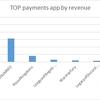
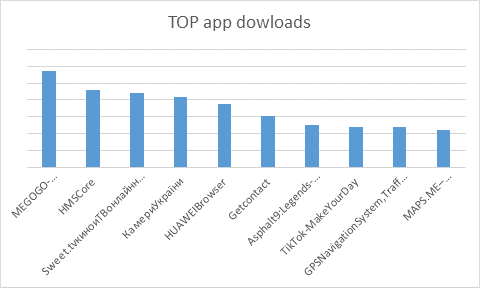
Top 10 most downloaded applications from AppGallery in Ukraine:
- MEGOGO
- Hms core
- Sweet.tv
- Cameras of Ukraine
- HUAWEI Browser
- Getcontact
- Asphalt 9: Legends
- Tiktok
- GPS Navigation System
- MAPS.ME
Curious that tops the list is localOTT service Megogo, the top ten also includes a new OTT player on the market - SweetTV. The presence of the preinstalled HMS Core and the Huawei browser in the list, apparently, can be explained by their regular automatic updates. Cameras of Ukraine and Getcontact (an application for blocking spam and determining the caller, an analog of Truecaller) speak about the interests of users best. Interestingly, the list includes the youth TikTok and the Asphalt 9 game. Two applications with navigation and cartography close the list. That is, someone uses alternative options for Google maps in Huawei Android smartphones, even if they are available.
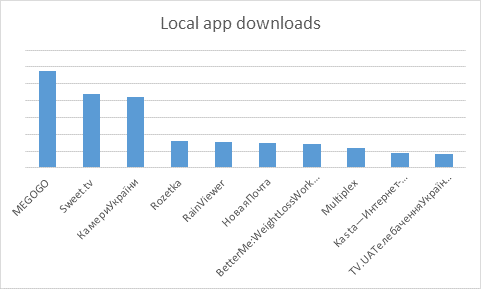
Top 10 most downloaded local apps from AppGallery in Ukraine:
- MEGOGO
- Sweet.tv
- Cameras of Ukraine
- Rozetka
- Rainviewer
- New Mail
- BetterMe: Weight Loss Workouts
- Multiplex
- Kasta
- TV.UA
List of the most downloaded applications createdUkrainian developers predictably top the products from the previous list. There are also Novaya Pochta and Rozetka, which are ubiquitous and included in the must-have list on a Ukrainian’s smartphone (but Privat24 is not included). There is the Kasta trading platform, the Multiplex cinema service, as well as the weather app (surprise) Rain Viewer and the local fitness app BetterMe: Weight Loss Workouts, created in Ukraine and already having more than a million installations worldwide. The list of top 10 (unexpectedly) is completed by the TV Week service tv.ua.
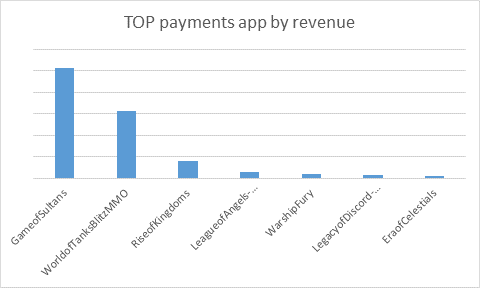
Top 10 most downloaded paid applications from AppGallery in Ukraine:
- Game of sultans
- World of Tanks Blitz
- Rise of kingdoms
- League of Angels
- Warship Fury
- Legacy of Discord
- Era of celestials
- Bigo live
- Looney Tunes World of Mayhem
- Tales of wind
Strictly speaking, the applications here are probably not paid,and having the ability to pay. It is logical that almost all of them are games (mainly multiplayer). Unexpectedly, except for the Bigo Live video chat and broadcast service.
Customer support
A reasonable person will say that all this is obviousnot enough to make life easier for the average buyer, inexperienced in the technical jungle, and he will be right. Therefore, Huawei took an unprecedented step by creating its own VIP service (the name, of course, is something else). Its essence is that when purchasing in a store, you can immediately seek help from a specially designated (and trained) assistant who will help those who are not good at technology. The help is to transfer data from your old smartphone to a new one. Creating a Huawei account, connecting to Huawei cloud services and installing the applications the user needs (we can assume that most often these will be Viber, New Mail and Privat24). However, you can only use the service once. Immediately upon purchase in a store or by contacting one of Huawei service centers within 12 months after purchase. Of course, the situation with quarantine and the need to order online complicates the situation, so it will be doubly interesting to see the results.
In the dry residue
Huawei's first AG smartphones in our market -Huawei P40 lite and Huawei P40 lite E will go on sale on March 25 with price tags starting from 7,000 and 4,000 hryvnia, respectively (the price offer will be valid until April 12, then the price may increase, I think by 500 hryvnia, or maybe not - time will tell ). This situation is truly unique - for several years now we have not seen a player capable of bringing a smartphone to the global market outside the Google and Apple ecosystems. It is worth recognizing that Huawei has done a huge amount of preparatory work both in terms of working with applications and services, and in servicing customers who will likely encounter difficulties in the operation of these smartphones. Will Huawei be able to make its smartphones attractive without Google services and contactless payment? What will win - the craving for a low price or the need for easy access out of the box to all the usual services? Nobody knows the answer to these questions yet. Huawei is going all-in, it simply has no other choice now. It will be interesting.