Employees at the University of Cambridge used sensors that were small in size, but sufficiently
In an experiment using cell linesIn humans, researchers have discovered that the heat generated when beta-amyloid aggregates can potentially cause other, healthy beta-amyloids to aggregate, causing more and more aggregates to form.
In the same series of experiments, researchers alsoshowed that beta-amyloid aggregation can be stopped and cell temperature reduced by adding a drug compound. The experiments also suggest that the compound has potential as a therapeutic for Alzheimer's disease, although extensive and clinical trials will be required first.
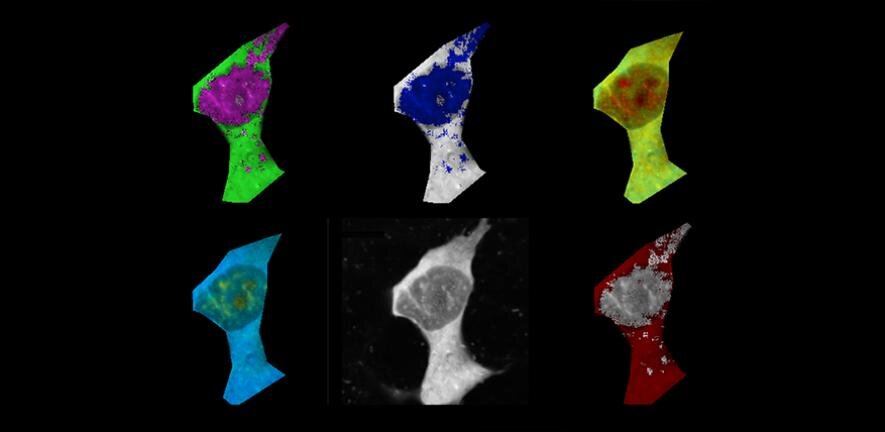 Mammalian cells stained with fluorescent polymer thermometers and falsely stained due to temperature gradients. Credit: Chi Wei Chang
The researchers say their analysis maybe used as a diagnostic tool for Alzheimer's disease or for screening potential drugs. The results were published in the Journal of the American Chemical Society.
Alzheimer's disease affects approximatelyThere are 44 million people worldwide, and there are currently no effective diagnostic or treatment methods. In Alzheimer's disease, amyloid beta and another protein known as tau form tangles and plaques, causing brain cells to die and shrink in size. This results in memory loss, personality changes, and difficulty performing daily functions.
Read more
Something strange is happening in the Universe: how to explain inconsistencies in the Hubble constant
The ancient city of the Mittani Empire “surfaced” from the river. He is over 3,400 years old
In 20 years everything will be different: what skills will our children need