An international team of scientists studied several lizard carcasses frozen in amber to understand what
When a being dies in nature, in decaycarcasses involved many different organisms, scientists explain. Analysis of the complex sequence of scavenging insects and larvae feeding on a dead organism at different stages is used, for example, in forensic science to determine the time of death.
In a new study, scientists examined three carcasseslizards trapped in resin and frozen inside amber, along with scavenging insects in an early stage of decomposition. Together with the carcasses of lizards, enclosed in a layer of resin, the researchers found a large number of necrophage flies from the Phoridae (humpback) and Empidoidea families.
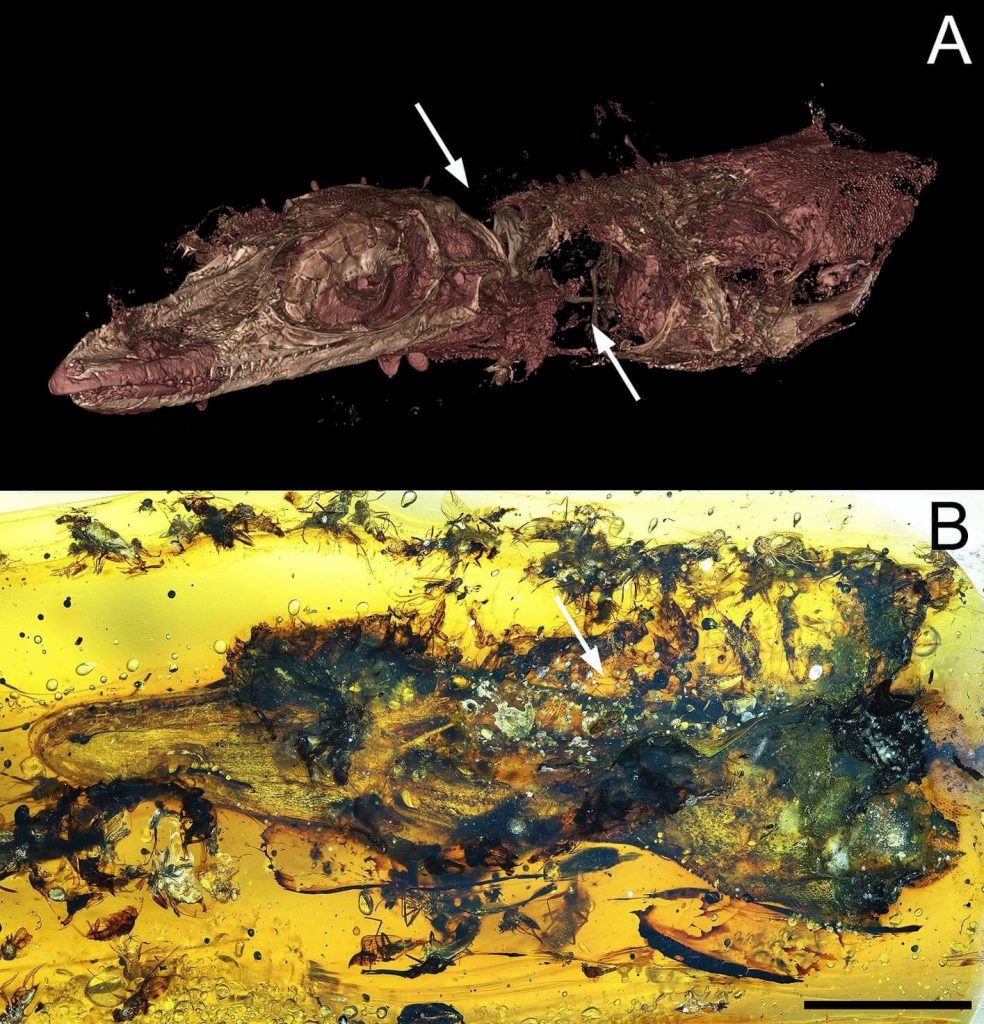 Reconstructed appearance of a lizard (top) andphotograph of amber (bottom). The protruding area, indicated by the arrows, apparently spread the smell of carrion and attracted insects. Image: Monica M. Solórzano‑Kraemer et al., Scientific Reports
Among the studied amber fossilsone specimen about 5 cm long is singled out, containing a lizard of the now extinct species Oculudentavis naga. This formation contains 13 resin layers and over 130 animal and plant inclusions. The peculiarity lies in the fact that the layer in which the lizard is enclosed protruded from the resin, spreading the smell of decay and attracting insects.
Numerous pieces of evidence show thatvarious families of flies still act as typical destroyers, visiting the carcasses of lizards at an early stage of decomposition, but so do ants, the scientists say. But in all studied samples of amber, these insects are absent.
Today, ants play a key role in removingfell in the rainforests - simply because of their huge mass. The fact that they are completely absent from the amber we studied suggests that stalking and decomposing carrion was not yet part of their feeding strategy at the time. Apparently, ants did not develop these skills until more recently.
Monika Solorzano-Kremer, head of research at the Senckenberg Research Institute
Read more:
The mystery of the red stripes on the satellite of Jupiter is revealed
Found "impossible" planet. She defies modern science
Mysterious hexagonal "honeycombs" in salt deserts found an explanation