In a new study, scientists have found that some species of amphibians glow when exposed to blue light -
This applies, for example, to tiger salamanders,which, when exposed to irradiation, become covered with shiny green spots. The Chak slingshot becomes covered with stripes of a poisonous blue color, and under the blue light, not only the skin of the marbled salamander begins to glow, but also its toes.
A new type of biofluorescence discovered by scientistsoccurs only when blue light hits an amphibian, whose skin and bones, in the case of the marbled salamander, absorb this wavelength and emit a different wavelength, which usually corresponds toelectric green.

This effect is different than usual.bioluminescence, in which an animal produces its own light through chemical processes or the luminous symbiotic bacteria that live in its body. It is precisely the luminescence resulting from irradiation.
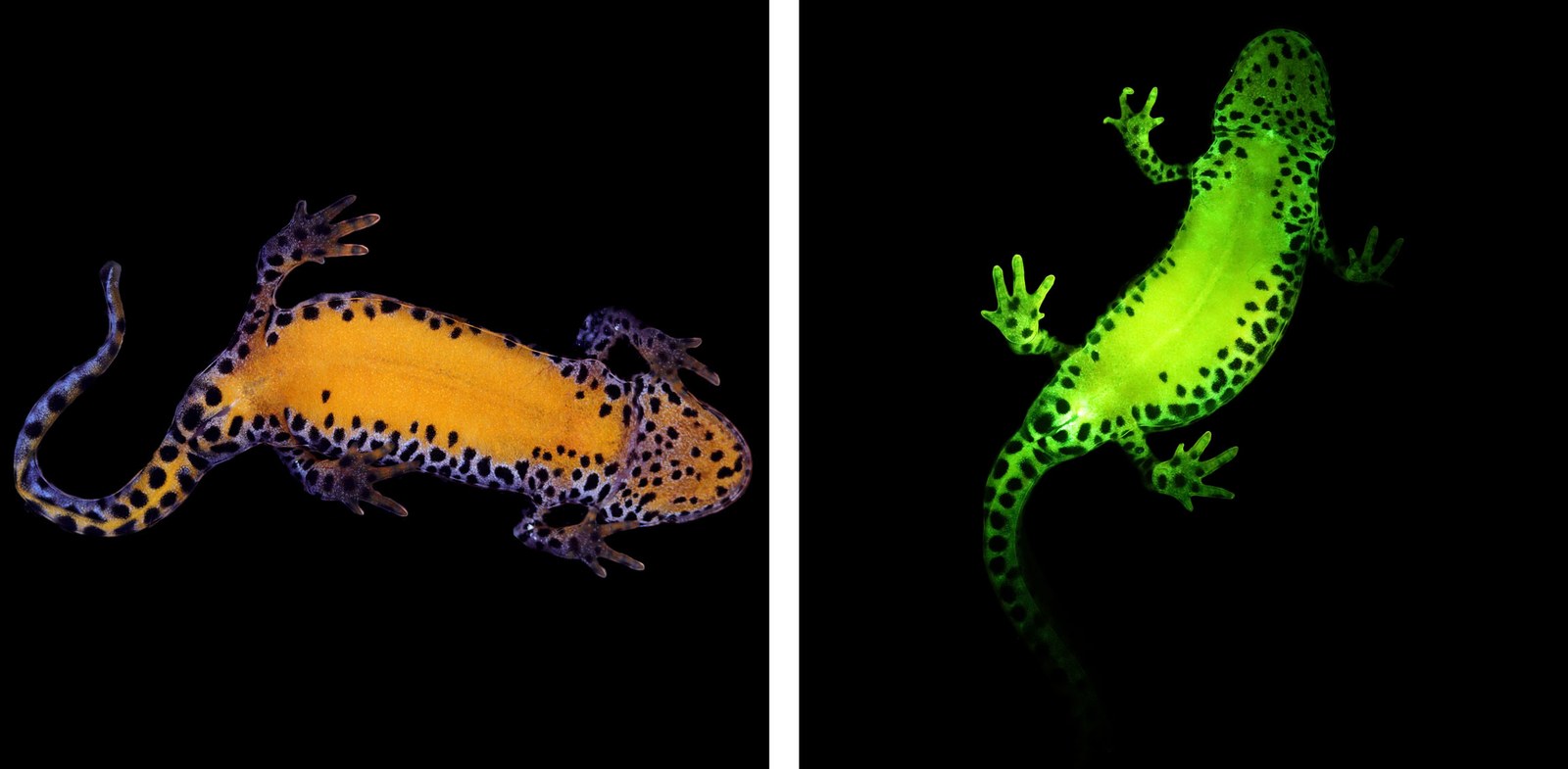
Researchers studied 32 species of amphibians - including eight out of 10 families of salamanders, and found that each species glows - some strongly, others less.
That no one has yet seen the glow,scientists explain that human vision can perceive a very small part of the electromagnetic spectrum, called visible light. This light allows us to see colors from red to purple, but other waves, from infrared to ultraviolet and radio waves, are invisible to our eyes.
Each species has its own way of perceiving the world— bees, for example, can see ultraviolet light, which many flowers emit to attract insects. This is also the case for amphibians: recent research has shown that they have a vision system that helps them distinguish colors in really dim light. Therefore, when amphibians are active in the cool evening hours, they can glow quite brightly to each other.
Earlier scientistsfound outthat tadpoles overcome the surface tension of the liquid by sucking out air bubbles.