Beta Technologies has announced plans to certify the CX300 electric aircraft, a fixed-wing version of the Alia eVTOL.
“Our eCTOL prototype has been flying for several years nowfrom airport to airport,” said Kyle Clark, the company’s founder and CEO. — Global operators are looking for practical solutions to help meet their sustainability responsibilities. They were interested in the cost and performance of our prototype and want to integrate it into their fleet. This is an opportunity to bring electric aviation to the market as quickly as possible.”
An eCTOL (Conventional Take-Off and Landing, eCTOL) aircraft is an aircraft with a conventional take-off and landing system.
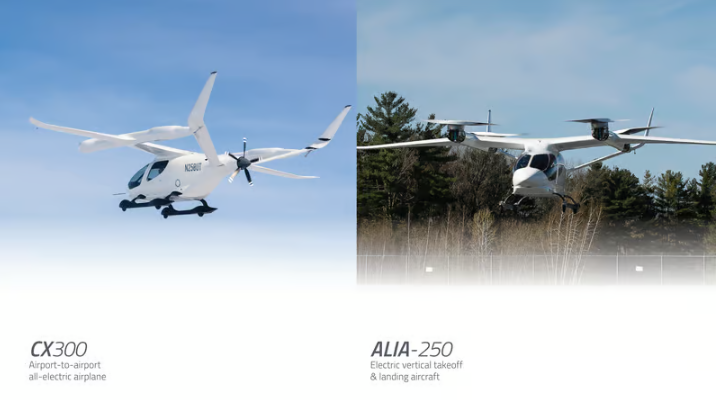 The CX300 is essentially a fixed wing version of Beta's Alia-250 eVTOL and is built on the same airframe, batteries, propulsion and systems. Photo: Beta Technologies
This eCTOL variant was called CX300, and, to date,time, he has already covered more than 35,400 km in the air. It is reported to be the only electric aircraft to have flown in busy Class B and Class C airspace, operating in a variety of weather conditions. Professional pilots have already appreciated it. The company also demonstrated that the aircraft can cover distance, flying 400 miles on a single charge between different parts of New York State (between Jamestown and Plattsburgh). This is almost the same as the distance between St. Petersburg and Moscow in a straight line.
A fixed wing aircraft is capable ofto fly thanks to the lifting force created by the aerodynamic shape of a fixed wing when moving forward at a certain speed, the development of which is achieved in various ways (usually due to the engine or through the rational use of rising air currents).
Read more:
The secret of longevity is revealed: scientists have figured out how to start the necessary mechanism in the human body
Named a new cause of autism
2,700-year-old temple found in Sudan He surprised scientists