Researchers from Flinders University have studied the remains of a giant bird, Dynatoaetus gaffae, which lived in Australia.
Biologists have studied the remains of fossil birds,found in Meirs Cave in South Australia, and combined the new data with previously discovered bones belonging to these birds from other caves on the continent. During the latest excavations, 28 new bones were found that belonged to fossil eagles. The find helped to recreate the appearance of birds.
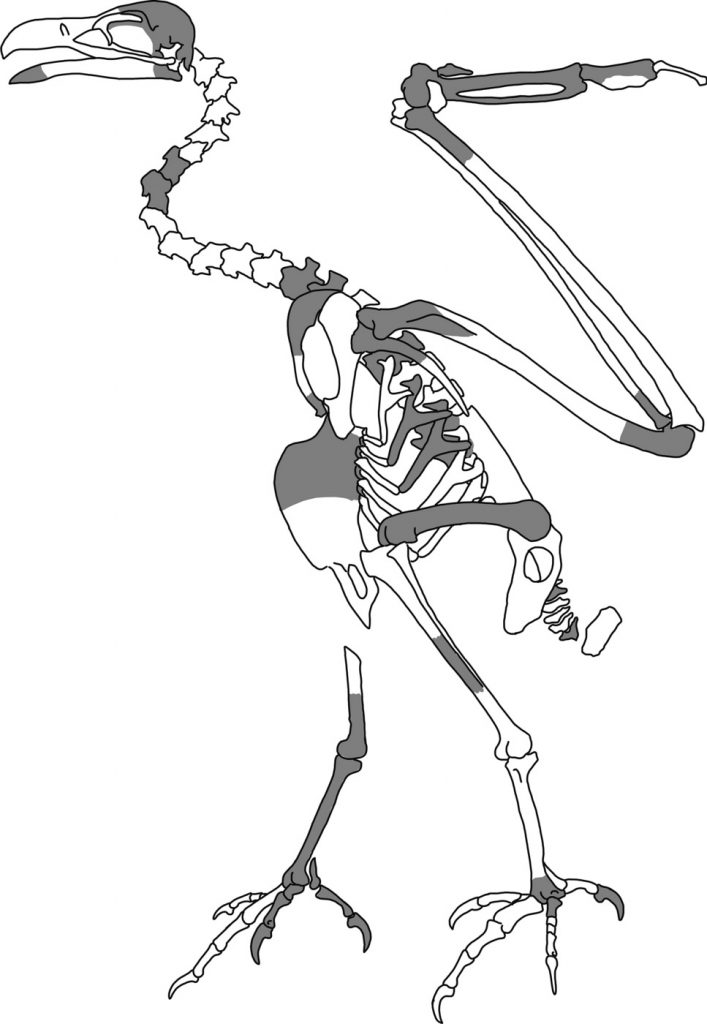 Reconstructed skeleton of Dynatoaetus gaffae. Found bones are marked in white. Image: Ellen K. Mather et al., Journal of Ornithology
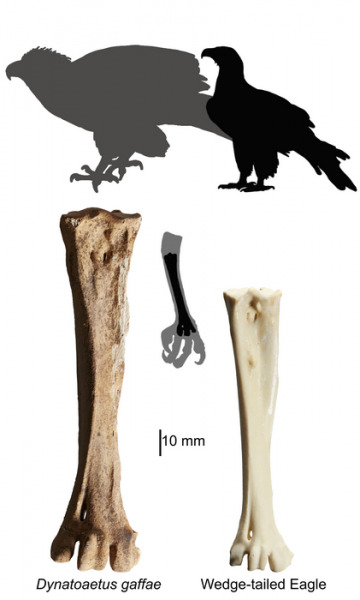 Comparison of the tarsus (one of the bird's leg bones) of Dynatoaetus gaffae (left) and the modern wedge-tailed eagle (right). Image: Ellen Mather (Flinders University)
The researchers note that the wingspanthe ancient eagle reached 3 m. In addition, he had giant claws (up to 30 cm in length). With these claws, Dynatoaetus gaffae could pick up or kill a young kangaroo, a large flightless bird, or other extinct megafauna of the era, including the young of the world's largest marsupial diprotodon (marsupial hippopotamus) and giant sand monitor.
According to scientists, Dynatoaetus gaffae was the sameas big as Haast's eagle, the largest known bird that lived in the past in New Zealand. The giant Australian eagle is part of the megafauna of the continent. In the past, Australia was inhabited by many large animals that began to die out in the late Pleistocene. The last representatives of the megafauna died after the arrival of the first people in Australia (about 40-50 thousand years ago).
Discovery shows it's incrediblethe bird family was once much more diverse in Australia, and that raptors also suffered from a mass extinction that wiped out much of Australia's megafauna.
Ellen Mather, paleontologist at Flinders University and study co-author
Read more:
One planet can put an end to life on Earth: how scientists have proven the fragility of the solar system
The secret of longevity is revealed: scientists have figured out how to start the necessary mechanism in the human body
Named one of the causes of aging and the way to “reverse the process”
On the cover: a fossil New Zealand Haast's eagle during a hunt. Image: John Megahan / PLoS Biology