Physicists from the Institute of Molecular Sciences of the National Institute of Natural Sciences of Japan have developed a new
In their work, scientists used opticaltweezers to capture two rubidium atoms cooled to near absolute zero and separated by just one micron. By hitting atoms with a special laser beam that glows for just 10 picoseconds (10 trillionths of a second), they fired the world's fastest two-qubit gate, creating quantum entanglement between two individual atoms in 6.5 ns.
Two-Qubit Gate - Basishigh-performance quantum computers. This is a logical operation on the quantum state of two qubits. The variation of the gate implemented in the study is a "controlled Z-gate". This is an operation that changes the quantum superposition of the first qubit from "0 plus 1" to "0 minus 1" if the second qubit is in state 1.
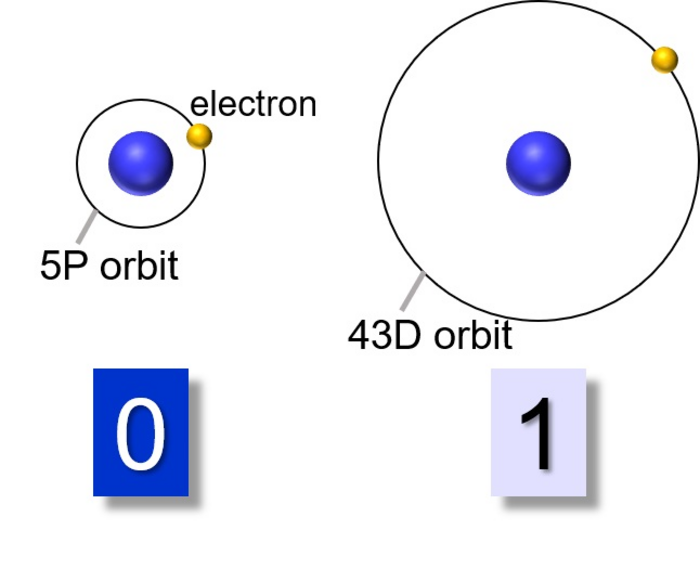
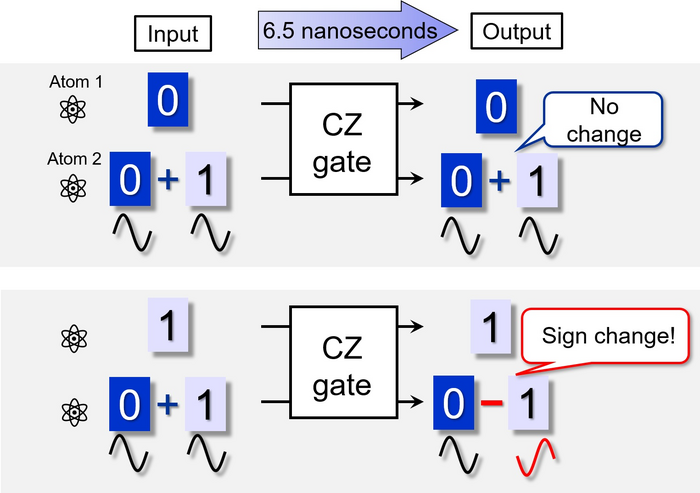
Left:The quantum state of the qubit is governed by the electron orbital. Right: Scheme of the device operation: depending on the state of the first atom, the laser action changes or maintains the value of the second atom. Images: Takafumi Tomita, IMS, National Institute of Natural Sciences
The accuracy (fidelity) of the quantum gate degradesdue to noise from the external environment and a working laser, which makes it difficult to develop quantum computers, the authors of the work explain. Because the noise time scale is typically greater than one µs, a quantum gate that runs faster will be able to avoid external interference. And this will increase the accuracy of calculations.
The quantum gate created by physicists worksat least twice as fast as noise, which means it can ignore it. The scientists believe the new technology will overcome the noise-related power limitation of superconducting and trapped ion quantum computers, which are currently considered the most promising.
Read more:
“This is science fiction”: scientists create a fundamentally new type of quantum computers
The length of the earth day is increasing. Scientists don't know why
What are supergenes and how do they make animals so weird