According to researchers from the Massachusetts Institute of Technology, today scientists do not
Difficulties in studying the underwater world are associated withthe fact that they require binding the research apparatus to the vessel on the surface or the constant replacement of batteries, the authors of the new development explain. This leads to the high cost of underwater expeditions.
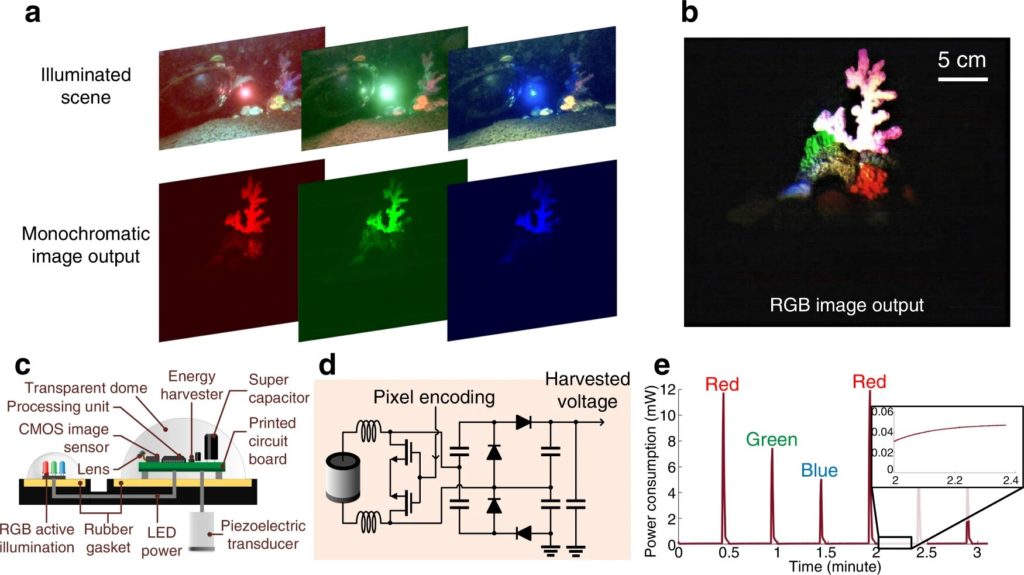 The camera uses three LEDs in seriesfor lighting (upper left), the created images are merged into one file (upper right). In the bottom row from left to right: side view, device diagram and its power consumption in different shooting modes. Image: Sayed Saad Afzal et al., Nature Communications
Engineers Introduce Batteryless Wirelessan underwater camera that is about 100,000 times more energy efficient than its counterparts. The device takes color photos even in the dark underwater and transmits the image data wirelessly through the water.
The standalone camera is powered by sound.It converts the mechanical energy of sound waves passing through water into electrical energy that powers its imaging and communications equipment. After capturing and encoding image data, the camera also uses sound waves to transmit the data to the receiver, which reconstructs the image.
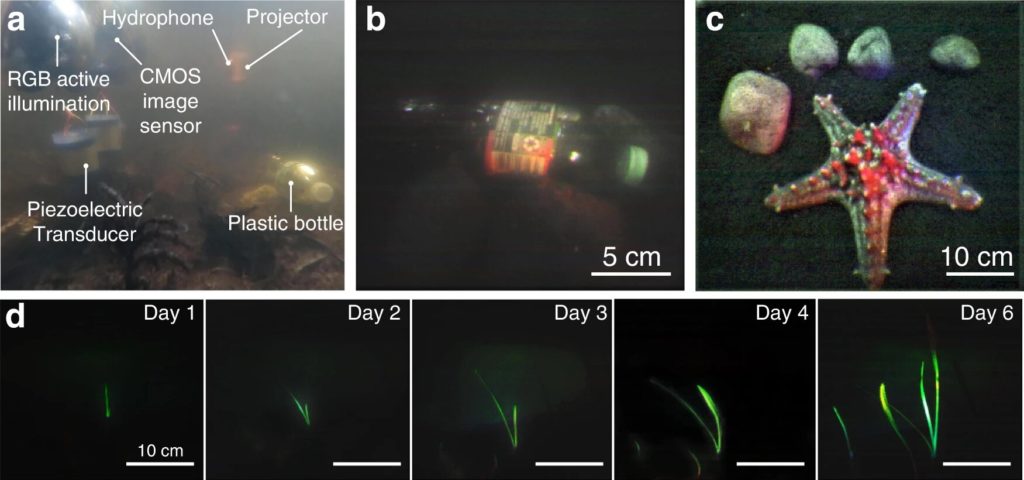 Underwater survey results. Image: Sayed Saad Afzal et al., Nature Communications
Since it does not need a power source, the cameracan work autonomously for several weeks, scientists say. With the new device, you can explore remote parts of the ocean and look for previously unknown species of animals and plants. It can also be used to capture ocean pollution or monitor the health and growth of fish farmed for aquaculture.
Read more:
It became known which tea destroys protein in the brain
Planetologists have found signs of life on Saturn's moon
Look at the first photos of Mars that Webb took: they are literally dazzling
On the cover: photo of an underwater camera. Image: Adam Glanzman, MIT