A recent image taken as part of the DESI Legacy Imaging Survey catalog shows a mysterious spherical
Whiting 1 is a faint and young globular cluster inSagittarius Stream. It is a complex, extended structure that consists of stars and revolves around the Milky Way in an almost polar orbit. Whiting 1 was originally thought to be a globular cluster formed in situ in a galactic halo. However, its young age and moderately rich metallicity do not match scientists' current understanding of typical objects of this type.
Comparing the relationship between age and metallicity,and the kinematics of the Sagittarius stream, scientists have learned more about the nature of Whiting 1. Astronomers believe that it is a member of a rare class of objects and, at a minimum, an unusual cluster. And also a descendant of the Sagittarius dwarf galaxy. It immigrated to our Galaxy along the Sagittarius stream as a result of galactic accretion.
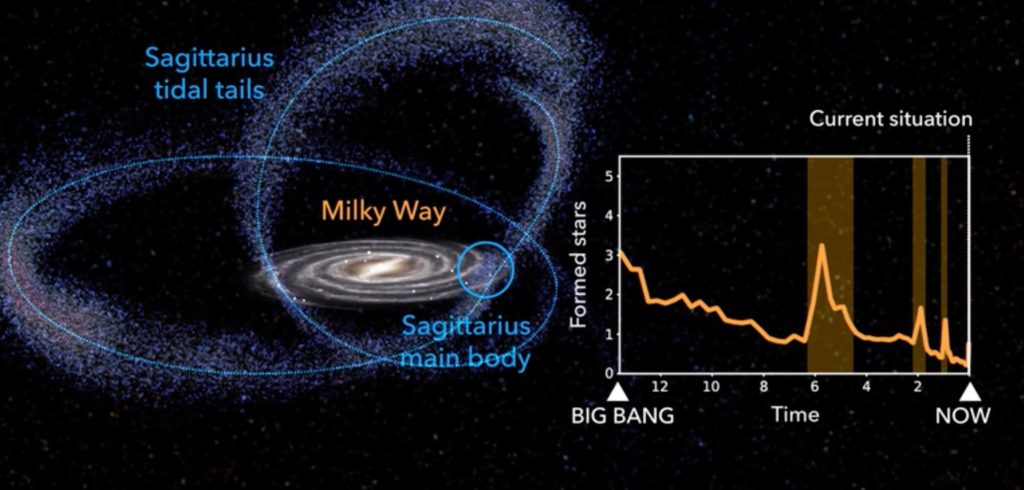 The Sagittarius dwarf galaxy accreted by the Milky Way.
Credit: Gabriel Perez Diaz
Scientists studied two tidal tails on either side of the cluster. Their shape and extent are direct evidence of Whiting 1's connection with the Sagittarius dwarf galaxy.
Whiting 1's intriguing origin makes the objectan ideal source for studying the formation of galaxy clusters, the authors of the study note. In the course of the new work, scientists have provided additional evidence that a dwarf galaxy may contain globular clusters and contribute to the formation of a galactic halo.
Read more:
A black hole in the galaxy proved Einstein right. The main thing
Space destroys bones and changes their structure: scientists do not know how people will fly to Mars
Astronomers have found planets that are different from Earth, but suitable for life