Physicists working at the J-PARC particle accelerator inJapan, for the first time synthesized the baryon resonance Λ(1405) by combining a negatively charged kaon and a proton. The study clarifies the properties of this unstable particle and its mass. Further analysis of Λ(1405) will help explain the internal structure of superdense neutron stars, scientists say.
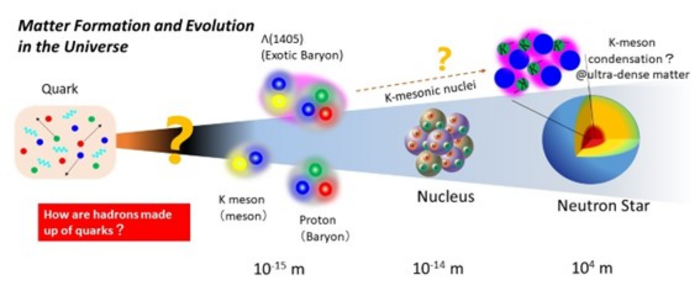 Schematic representation of the evolution of matter and baryon resonance Λ(1405). Image: Hiroyuki Noumi
Standard Model of Particle Physicsbelieves that all matter consists of fundamental quantum fields, the quanta of which are 6 leptons, 6 quarks and their corresponding antiparticles. As a rule, quarks do not exist separately, but are combined in groups of two and three, forming hadrons, for example, protons and neutrons. A resonance in this model is a short-lived excited state of hadrons.
Physicists have been studyingbaryon resonance Λ(1405). But despite years of research, the unusual properties of this resonance are difficult to explain. For example, it is not clear why it has the lightest mass among the negative parity baryons, although it contains a heavier strange quark, the researchers note.
To answer these questions, physicists conductedparticle accelerator research. During the experiment, negatively charged kaons or K-mesons (hadrons consisting of one strange quark and an up antiquark) were shot at a deuterium target, each of which had one proton and one neutron. In a successful reaction, the K meson knocked out a neutron and then merged with a proton, creating the Λ(1405) resonance.
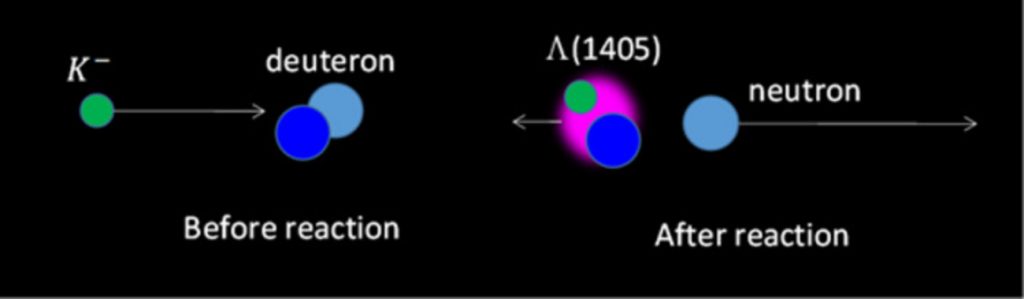 Scheme for obtaining Λ(1405). Image: Hiroyuki Noumi
By analyzing decay products, physicists have measuredcomplex mass Λ(1405). The researchers note that the formation of a bound state of the K-meson and proton was possible only because the neutron carried away some of the energy.
The results of the study confirm that Λ(1405)is an unusual state formed from five components - four quarks and one antiquark. It is best viewed as a temporary bound state of a K meson, consisting of a strange quark and an up quark, and a proton, containing two up quarks and one down quark.
Physicists point out that a better understanding of the baryonicresonance will help to more accurately describe the properties of the ultra-high-density matter that exists in the core of a neutron star, as well as the processes of the formation of the Universe shortly after the Big Bang.
Read more:
Earth's core will soon be spinning in a different direction
Watch the hydrogen superyacht 'fly' over the water at 75 knots
The Milky Way is abnormally large for its galactic filament
On the cover: J-PARC proton accelerator. Image: Patrick Dep, CC BY-SA 2.0, via Wikimedia Commons