Aurora photographer Todd Salat recorded an unusual aurora in the form of
Salad photographed the aurora in the sky abovethe summit of Donnelly Dome, formed as a result of glaciation that occurred between 70,000 and 100,000 years ago. “I was extremely surprised and puzzled when I first saw a distant bright light coming towards me from the northern horizon,” Salat told spaceweather.com.
The researcher noticed a bright light ahead andat first I assumed that it was a jet plane that flies through the clouds. But soon it took the form of a spiral and began to grow rapidly. After about 7 minutes, the bright area swept by and disappeared. The photographer posted the resulting image on his Facebook page*.
* Meta Platforms Inc. recognized in Russia as an extremist organization. The company's activities for the sale of products - social networks Facebook and Instagram on the territory of the Russian Federation is prohibited.
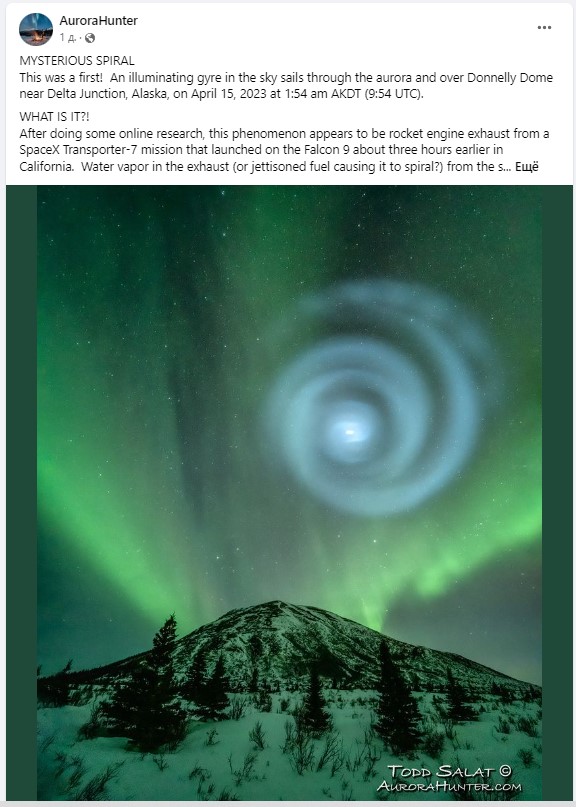 Photo of an unusual spiral during the aurora, published on the photographer's page on the social network
spaceweather experts.com notes that such bizarre "unidentified objects" are formed after the launch of the Falcon 9. Three hours earlier, the SpaceX rocket launched from the spaceport in California. It launched 51 small satellites into Earth orbit. As the ejected upper stage of the rocket flew over Alaska, it released unused propellant. A slight rotation turned the harmless cloud into a spectacular spiral.
Similar unusual "patterns" in the sky have been seen after many Falcon 9 launches in different regions over which the rockets flew.
Read more:
Scientists have called the main “trick” of the brain: how it deceives a person
In space, no one will hear your cry: 7 action-packed books about the secrets of the universe
"Sea" of quarks inside one proton: what does an elementary particle consist of