In the search for the missing components of the universe, scientists have already proposed all sorts of theories about what exactly might be
Since 2015, humanity has been able to pick up these ripples using the Laser Interferometer Gravitational-Wave Observatory (LIGO).Every time two very heavy objects collide far away in the universe, they createA ripple that moves through space, bearing the signature of what created it.Whether it's the collision of two black holes, pairs of neutron stars.
In an article, Esquiaga and co-author Miguel Zumalacarregi argue that if such waves strikeOn a supermassive black hole or cluster of galaxies on its way to Earth, the signature of the ripples will change.It is the difference in the gravitation of objects, provided by Einstein's theory, that makes it possible to determine the signatures of cosmic bodies by waves.
For example, one of the theories of the missing part of the universe is the existence of an extra particle.If a traveling gravitational wave hits a supermassive black hole, it generatesDepending on what the wave collides with , the signature of the gravitational wave cancarry an "echo" or be displayed in encrypted form.
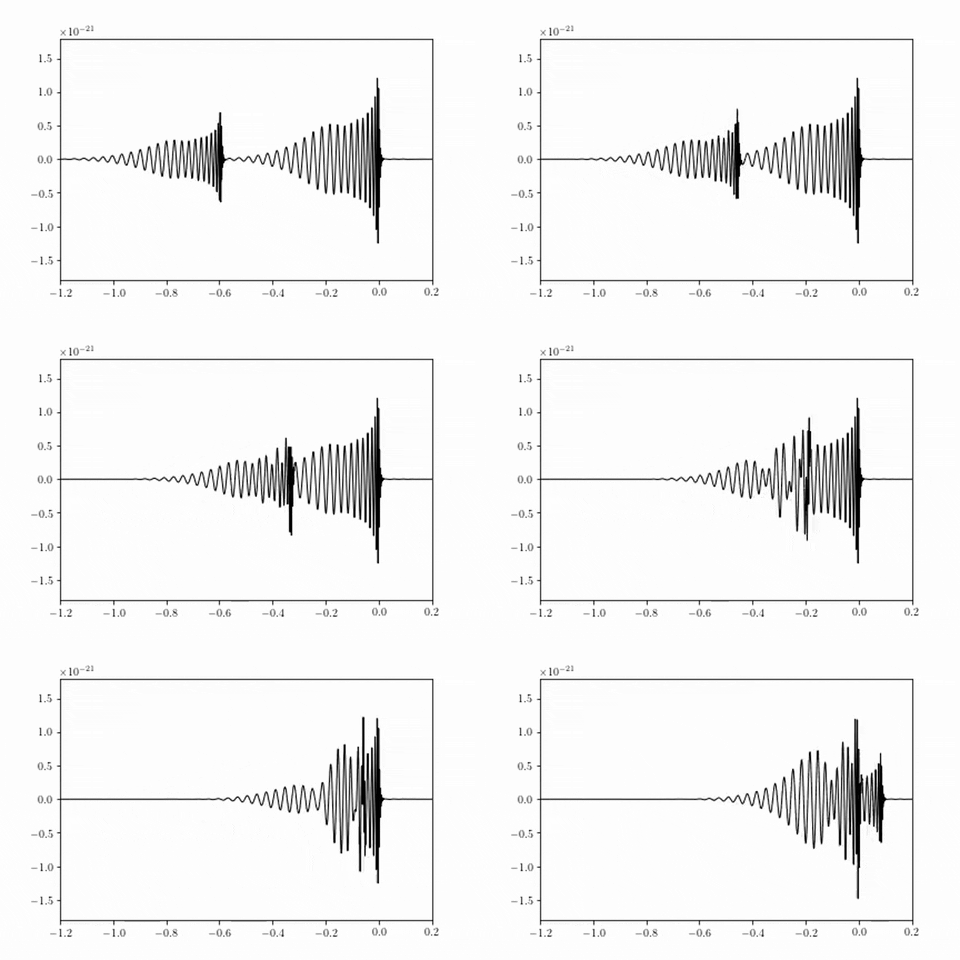 An illustration of mixing waves and creating a new signature in them. Credit: Eskiaga and Sumalakarregi.
Scientists believe this is a new way to study the Universe and uncover its last secrets.
Read also
Abortion and science: what will happen to the children who will give birth
Check out the most beautiful pictures of Hubble. What has the telescope seen in 30 years?
NASA published a photo of the Earth from the moon, which was taken in 1968