Scientists have conducted a new study and found out the true nature of ancient images and figures of owls. It turned out,
Employees of the Spanish NationalResearch Council examined 100 of the 4,000 engraved slate plaques with owls that archaeologists had collected for years from burial sites scattered across the peninsula. All of the carvings date from the Copper Age (3500–2750 BC).
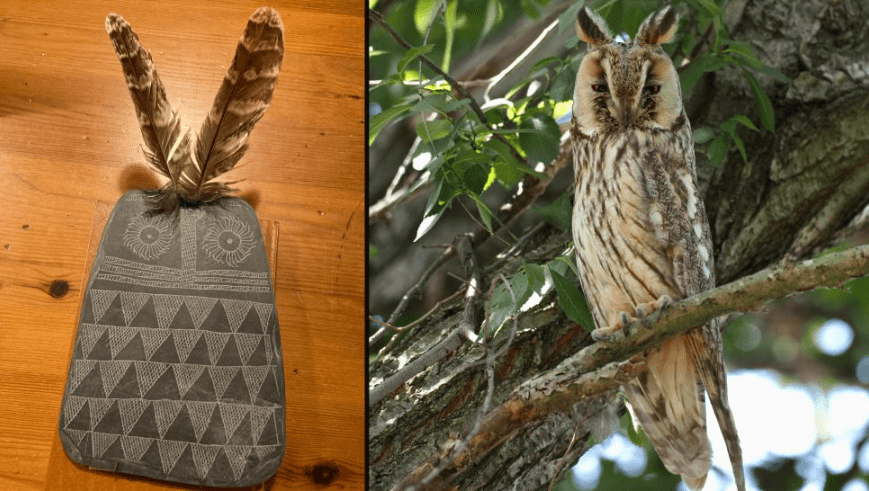 A replica (left) of a carved stone owl with two feathers inserted at the top next to a photograph (right) of a long-eared owl (Asio otus). Image courtesy of Juan J. Negro
They were judged by how much they wereworked out: how the eyes, feathers, beak, wings are depicted. The “cartoonishness” and simplicity of the drawings made scientists think. In addition, slate was used to make amulets. This material is easy to engrave.
When one of the scientists studied the figurines, he thought,that they are pretty easy to make. He and his colleagues suggested that they were made by children. To test this theory, the researchers asked a group of modern-day children to draw pictures of owls, and the resulting artwork looked very similar to ancient drawings.
“We view the creation [of owls] as part of the educational process for young people,” the scientists conclude.
Read more:
A magnetic storm is about to hit Earth
Named the main danger of the lunar mission "Artemis"
The true meaning of mummification is revealed: all this time, scientists were wrong
On the cover: an ancient image of an owl on slate next to a photograph of a small owl (Athene noctua). Image credit: Museo Arqueológico de Sevilla, Spain and Juan J. Negro
</ p>