Scientists from Cornell University studied an embalmed bird that over the years
Based on the analysis of the images, the scientists found thatthe embalmed bird was actually a sacred ibis. It is a clumsy, long-legged bird similar to a stork and a heron, with a black head and black and white wings. Ibis were revered in ancient Egypt, which gave them such a name.
Scientists note that the Egyptians mummified everythingfrom cats and dogs to snakes and baboons, and even crocodiles. Animals that had not yet died of natural causes were killed. As a rule, they were disembowelled, and the bodies were lowered into a boiling vat of resin, which usually burned the bones to dust. However, as noted by the university, this does not apply to the mummy of the bird, since CT showed the remains of the skeleton and soft tissues.
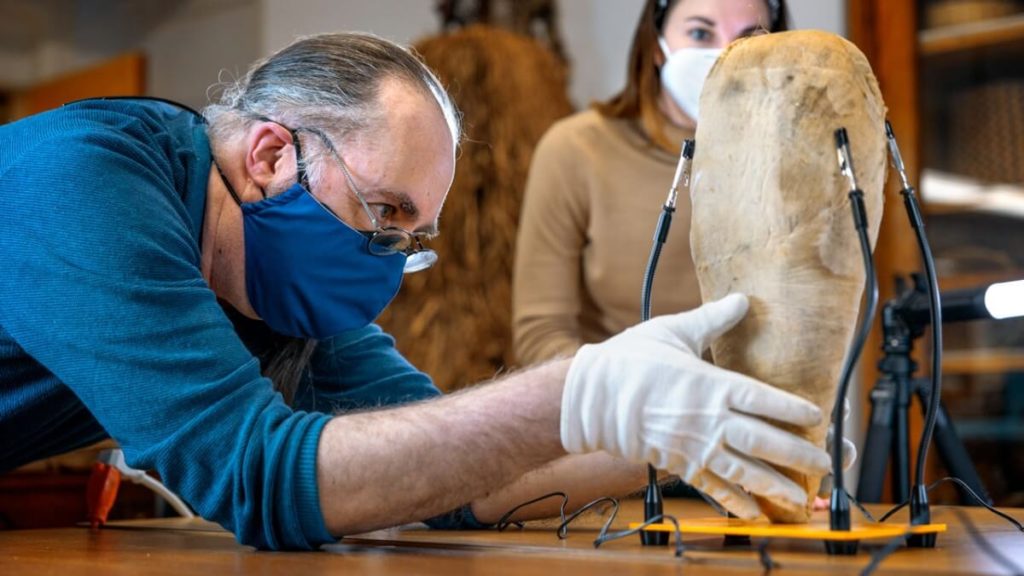 Photo: Ryan Young/Cornell University
Now researchers are working on a way to create a 3D model of an object that does not require violating the integrity of the found artifact.
“Most archeology is destructive,” Glich notes. - Once you unearthed something, it was already impossible to restore everything as it was. Once you've unwrapped the mummy, you can't put it back together."
Cover photo: Ryan Young/Cornell University
Read more
Look at the "silent" drone with a new generation of ion propulsion
Flashes of energy for thousands of years of life: scientists have understood how they appear on the Sun
NASA has published the "sounds" of a black hole: anyone can listen to them