Researchers led by Harvard University have reconstructed the fossil's skeleton.
The rarity of early tetrapod specimens in the annalsFossils is a problem for scientists who often work with incomplete fossils or groups of species. Whatcheeria, however, is a unique exception because it consists of hundreds of bones from several individuals of varying sizes, all preserved at one site in Iowa.
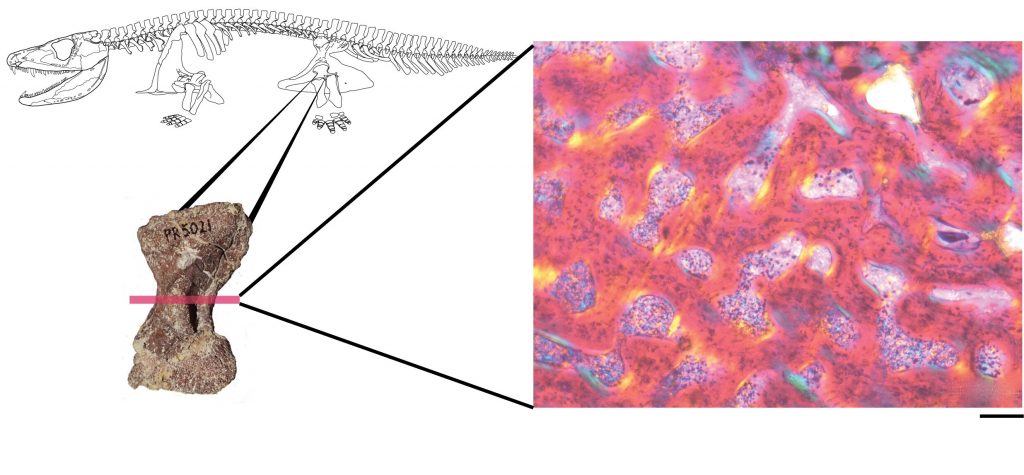 Skeletal reconstruction and tissue section of a juvenile Whatcheeria deltae. Fibrolamellar tissue is visible on section. Image: Megan R. Whitney et al., Communications Biology
Scientists studied the growth of Whatcheeria on four differentstages of life by analyzing the type of bones present in specimens of different ages. Bone organization can be used as an indicator of growth rate. The researchers found disorganized, fibrolamellar bones in young animals and more organized patterns in adults.
These data indicate that at the beginningDuring its lifetime, Whatcheeria grew rapidly and quickly reached gigantic proportions. This was followed by a stage of slow and limited growth in adults.
Whatcheeria resembled a huge salamander withstrong legs and arms that supported her weight on dry land. At the same time, animals have a number of anatomical features that allowed them to exist in water. Researchers believe that members of the Whatcheeria family lived on the outskirts of low-lying land lakes on the border of water and land approximately between 331 and 326 million years ago.
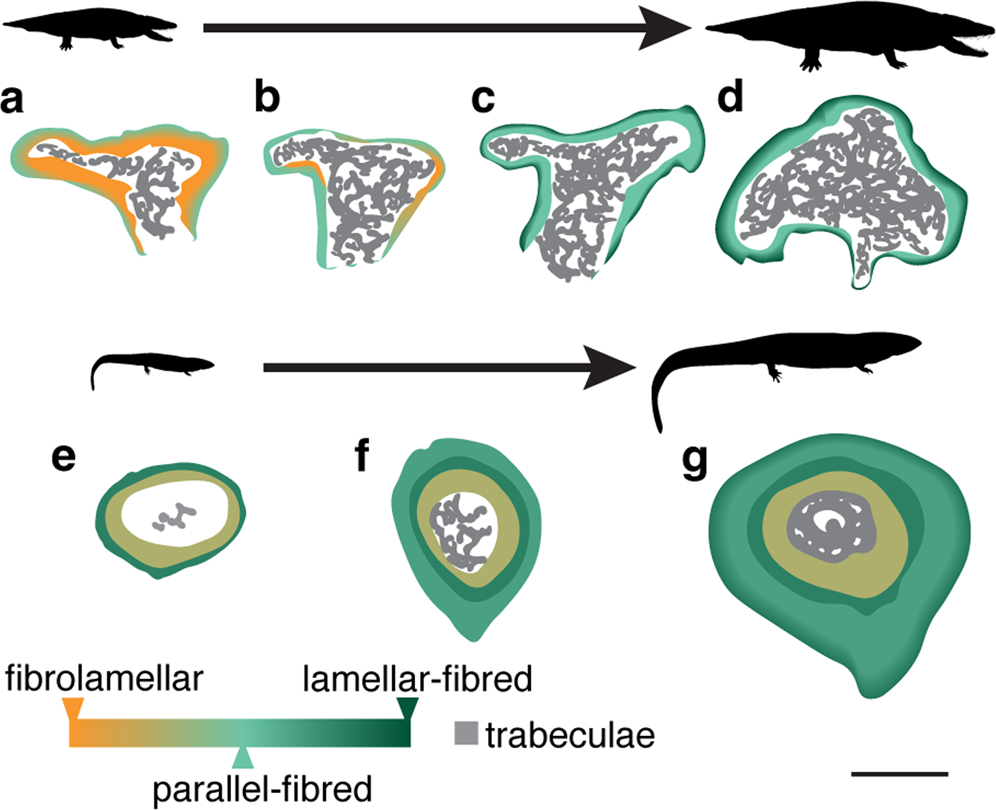 Comparison of bone sections at different ages in rapidly growing Whatcheeria (top) and gradually developing modern salamanders (bottom). Image: Megan R. Whitney et al., Communications Biology
For a long time it was believed that these early animalsgrew very slowly throughout their lives, gradually becoming larger and larger, like modern salamanders. The discovery of alternative mechanisms is forced to reconsider all ideas about the evolution of four-legged animals, the scientists add.
Whatcheeria is one of the largest animalsfound at a fossil site in Iowa. The researchers believe that Whatcheeria grew rapidly to quickly reach the large size needed to be the top predator in the environment - the Tyrannosaurus rex of its time.
Read more:
The creator of the space elevator: "Transit into space will appear within 10 years"
Look at the result of a "head-on collision" of two galaxies: this is a very rare occurrence.
Wolves infected with toxoplasmosis are 46 times more likely to become pack leaders
On the cover: Whatcheeria's reconstructed face. Image: Nobu Tamura, CC BY-SA 3.0 via Wikimedia Commons