A group of astrophysicists led by the Portuguese research institute Instituto de Astrofísica e Ciências do
The researchers used data from spacethe Kepler telescope to search for seismic activity inside red giants. The study of waves propagating during "starquakes" allows you to "look" inside the star, to determine its structure and properties. In their work, scientists analyzed seismic waves that go into the deepest layers of the giants.
An animated representation of seismic waves propagating inside a star and "revealing" its properties
Astrophysicists have analyzed 359 red giantswith masses below a certain value, in order to measure their individual fluctuations and the various properties of these stars. They found that almost 7% of these stars have structural breaks in their interiors. They affect the frequency and course of sound and gravitational waves, which cause changes that affect the brightness of stars.
There are two theories that try to explain howsuch violations occur. The first suggests that they exist throughout the evolution of the star, but, as a rule, are not very intense. The second is that these irregularities are "smoothed out" by an unknown physical process, which subsequently leads to changes in the structure of the star's core. These studies provide preliminary support for the first theory, but more data are needed to draw firm conclusions.
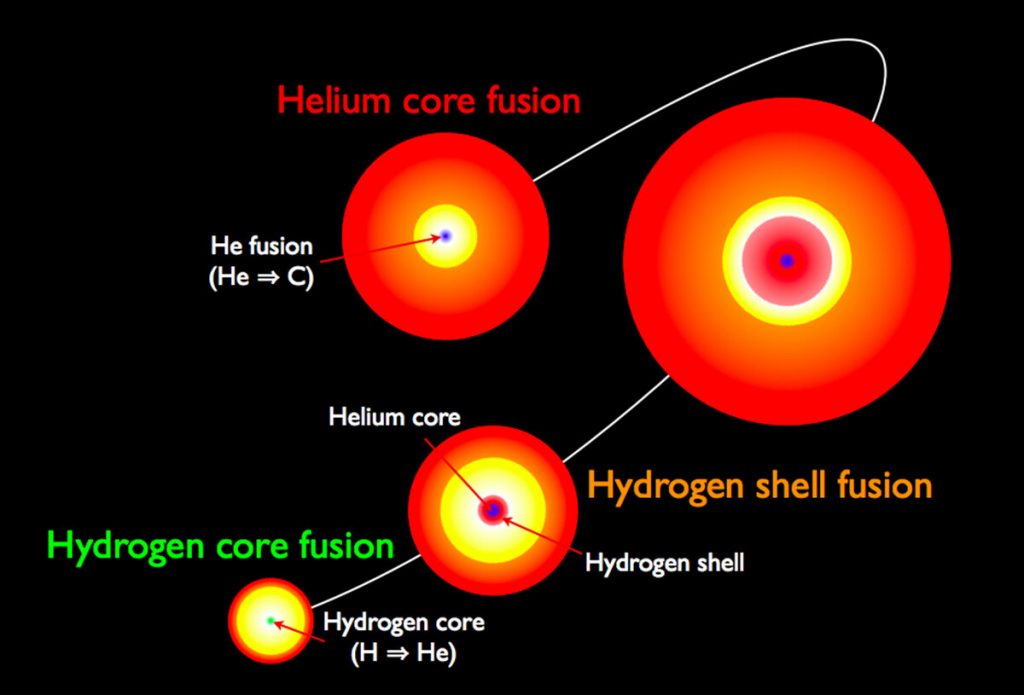 Evolution of a star into a red giant. From the hydrogen core fusing helium (lower left corner) to the helium core fusing carbon (upper left corner).
Red giants are dying starsin the last stages of stellar evolution, having exhausted the reserves of hydrogen in their cores. Low-mass red giants that have just entered the stage of helium fusion are often used by astrophysicists in research to determine distances and galactic density, as well as to better understand the physical processes that determine the chemical evolution of stars. This is why an accurate understanding of internal evolution is so important, the scientists explain.
Read more:
Hydrogen energy, material against cold weather and bioadditives against COVID-19: what scientists are creating in the North
Scientists have found out who benefited from the death of dinosaurs
Look at the photo of the Earth from space: it was made by the first private module
On the cover: illustration of red giants. Image: NASA