Scientists from Stanford University have developed an underwater archaeological robot, OceanOneK. Its upper part
Haptic or touch feedback systemrobot and stereoscopic vision create an incredibly realistic experience, say scientists who have already used the capabilities of OceanOneK. “It feels like you’re deep underwater, not on board a ship, in a control center,” said Osama Khatib, a robotics specialist at Stanford University, in an interview with the university’s newspaper. Looking through the eyes of the robot OceanOneK and feeling the sunken Crispy's ship with mechanical hands, the engineer even felt the resistance of the water.
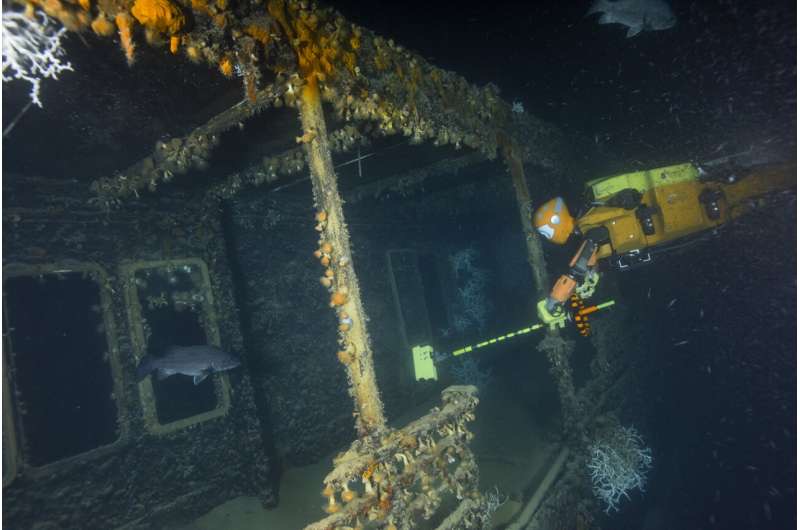 Photo: DRASSM, Gedeon, Stanford University
The predecessor to OceanOneK, OceanOne was built fordiving depth of no more than 200 meters. To modernize the model, the researchers equipped the hull with a special foam made of glass microspheres, which provide buoyancy and at the same time can withstand enormous pressure at a depth of 1 km. It is 100 times more than usual. In addition, the robot's arms are filled with oil and a spring mechanism that compresses it in response to external pressure, preventing destruction and cushioning the electronics.
The engineers also updated many tiny components throughout the OceanOne body to minimize the amount of compressible air in its individual parts and keep the robot as compact as possible.
Read more:
Physicists have found a universal "clock" in space: they are more accurate than atomic
Archaeologists have found drawings of creepy people with huge heads: who they were
The James Webb telescope took the first picture of Jupiter: it shows 9 moving targets at once