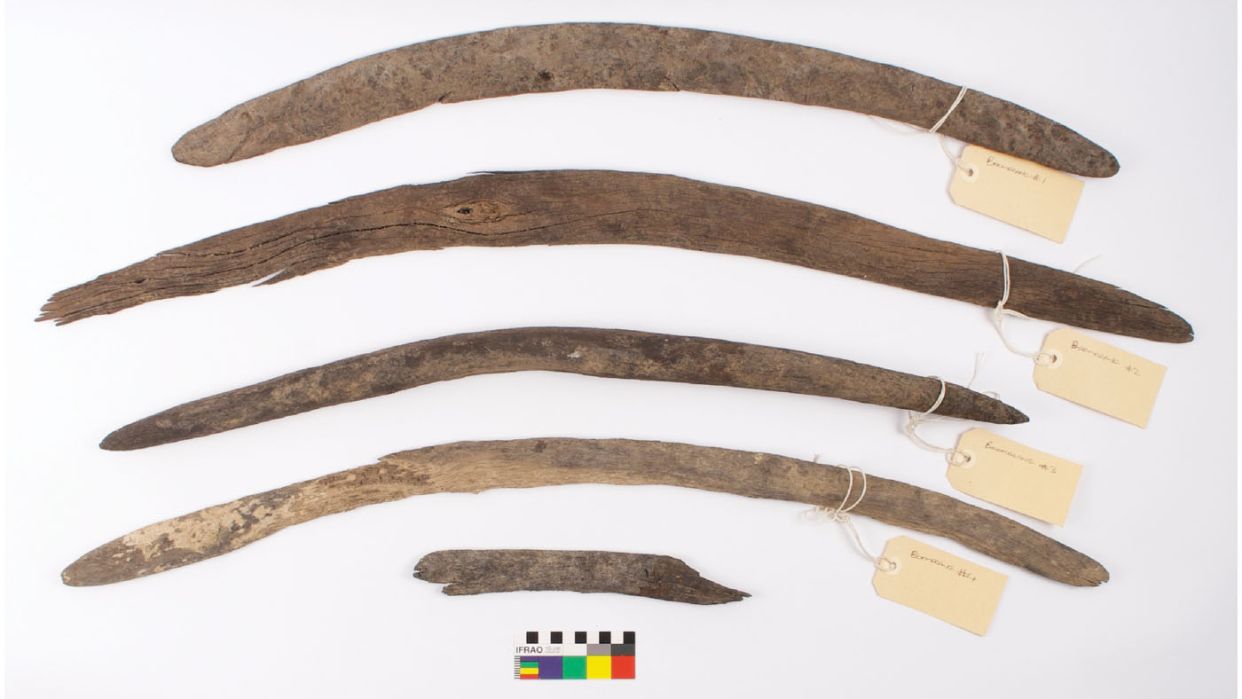
Scientists found five rare “non-returning” boomerangs in a dry river bed in the South
In total, archaeologists found four completeboomerang and a fragment of the fifth. Radiocarbon dating has shown that Aboriginal people made boomerangs from wood between 1650 and 1830 - even before the first Europeans explored the area. Lead researcher Amy Roberts, an archaeologist and anthropologist at Flinders University in Adelaide, said the artifacts provide a rare insight into what life was like for the southern continent's indigenous people.
Since aboriginal boomerangs are made of wood,they decompose quickly in air. This is only the sixth time they have been discovered in their archaeological context. This was helped by drought. The ravines of the Cooper Creek river system are usually filled with water, but in late 2017 and early 2018, the river dried up, exposing the channel and partially buried boomerangs there.
 Australian archeology
Perhaps the aborigines dropped boomerangs in anotherplace, and then the water washed the instruments into the river system. But, most likely, the natives threw boomerangs across the river to intimidate the waterfowl and they got caught in the net. This is the traditional hunting method of indigenous Australians.
At the same time, scientists note that the length of theThe largest of the recently discovered boomerangs was 1 m. It was probably too heavy to be used as a projectile and was mainly used in hand-to-hand combat.
Regular boomerangs fly away and then return tothrower. But there are also "irrevocable" boomerangs - they were widespread among the Australian aborigines. As a rule, throwing sticks were distinguished by their large size and weight, as well as a characteristic bend or "elbow" that made them spin in flight. As the authors of the study note, the fact that boomerangs must necessarily rotate is a stereotype of modern people. Now their "irrevocable" versions can really be considered a strange hunting weapon. But for the natives, this was the norm.
Ethnological studies show thatAboriginal men kept different types of boomerangs in camps - for dancing, hunting, fighting, and ceremonies. Similar throwing sticks were used in other parts of the world, including Ancient Egypt, Poland and North America. But now boomerangs are primarily associated with Australia.
Read more
Space exploration can cause humans to contract extraterrestrial viruses
Biologists have created a bacterium that destroys the protective shell of cancer cells
"The Last Hero": These missions will no longer return to Earth, but continue to transmit information
Radiocarbon dating - a varietymethod of radioisotope dating. It is used to determine the age of organic remains by measuring the content of the radioactive isotope ¹⁴C in the material in relation to the stable isotopes of carbon.