Researchers found a painted rock in the Svaga-Svaga Hunting Reserve, it was one of 52
What caves are we talking about?
The cave is called Amak'hee 4.It depicts three unusual humanoid figures with large heads.
Archaeologist Maciej Grzelczyk of the Jagiellonian University in Poland has estimated that Amak'hee 4 is several hundred years old, so it is difficult to determine the exact date of the drawings.
In the cave there are five figures drawn in whitepaint, and almost all the rest are completely painted with red pigment. It was obvious that the red pigment was formed due to climate change and was now eroding. It is also known that the cave was not inhabited by domesticated animals that could have left pigment, since the work dates back to an earlier period, before people learned to raise and keep livestock.
This suggests that the drawing is rather old.and dates back to the hunter-gatherer society in the region. In addition to strange people, there are animals in the cave that look like wildebeest, buffalo and giraffes.
Who were the big-headed creatures?
In 2021, Grzelchik wrote that in the paintings inAmak’hee 4 shows a triple figure. It could be three buffalo heads. He said the shape of the skull is similar to that of a buffalo, with a dip in the center and the horns rising and curving outward.
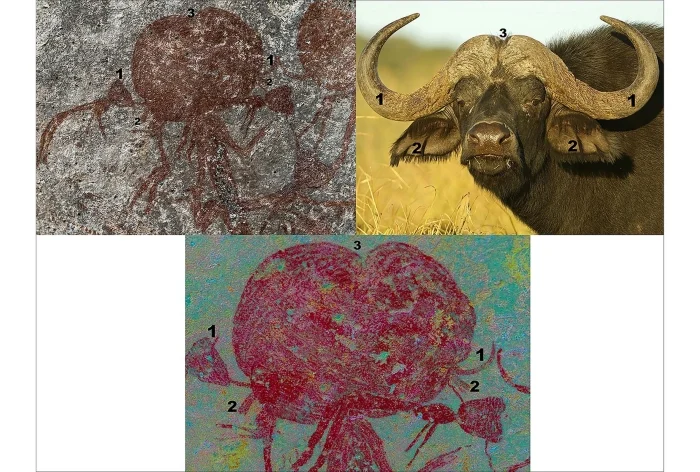
According to him, it is reminiscent of the Sandawe culture -people who descend from those who lived in the region before. The buffalo is an important part of the rituals of this people. But they didn't have motives about people with buffalo heads or buffalo werewolves. These images may be something else. However, Gzhelchik notes, buffalo horns do play a significant role in some Sandawe rituals.
Archaeologists believe that these mysterious figuresthere may be a not so mysterious explanation. A little further from Amakhee 4 in central Tanzania there is the Kandoa region, where two rock paintings of three similar figures were also found.
One place is Kolo B2, where three figures stand side by side, and Kolo B1, where the figures are drawn horizontally and lie on the ground.
Amak’hee 4, Kolo B1 and Kolo B2 have one andthe same trio with a big head. But two sites in Kolo have stripes that could be considered headwear. Another interpretation is that the figures have an unusual hairstyle.
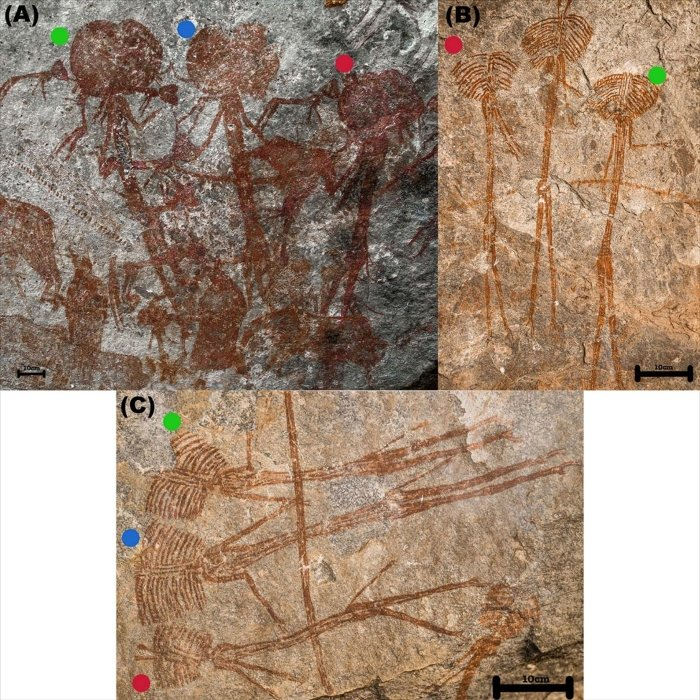
All three drawings have one common element - the central line that runs down the middle of the drawing. Also, all the figures have a similar direction and position of the hands.
Why could people with big heads mean very different things?
But the drawing in Amakhee 4 is different in that the head is painted in one color and is focused on more than the rest of the image elements.
In addition, the drawings in Kolo B1 and Kolo B2 are largerfocused on the motive of the trio, and not on its members themselves. Gzhelchik also noted that the Kolo drawings are isolated and have no connection with the rest of the depicted rock art.
In the Kandoa region, where Kolo B1 and Kolo B2 were found,the Sandawe people still use drawings for various rituals. Recently studied local communities live there, which may help to understand what these unusual drawings mean.
Read more:
The James Webb telescope took the first picture of Jupiter: it shows 9 moving targets at once
Scientists understand why T-Rex and other large dinosaurs had small "hands"
The oldest Voyager 1 mission has a strange glitch that cannot be fixed