Fossil plants preserved by a volcanic ash fall in China have shed light on
Noeggerathiales were important peat-formingplants that lived from 325 to 251 million years ago. Understanding of their relationship with other plant groups has so far been limited to poorly preserved examples. Fossils found in China have allowed experts to understand that Noeggerathiales are more closely related to seed plants than other groups of ferns.
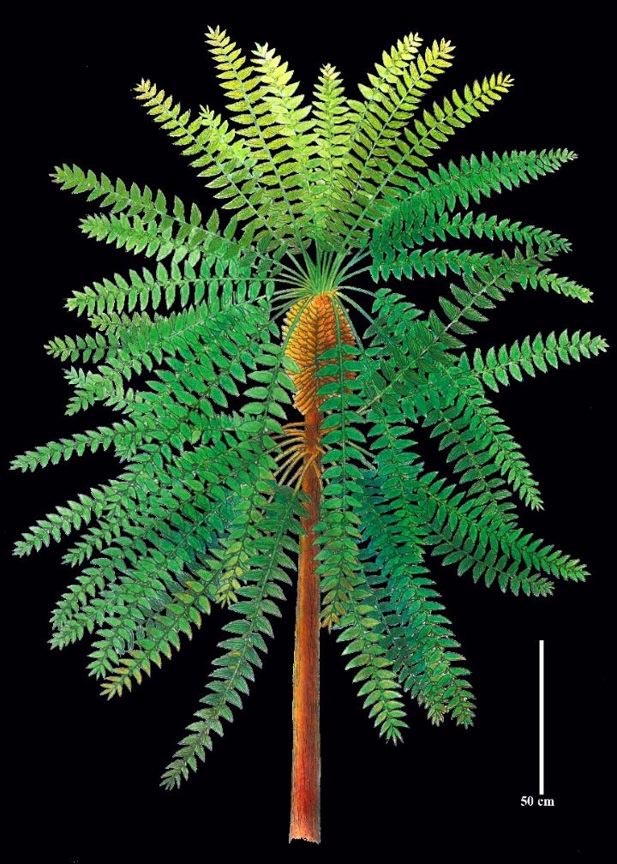 Reconstruction of the crown of Paratingia wuhaia sp:
They are no longer considered an evolutionary dead end.They are now officially recognized as advanced tree ferns that have evolved complex cone-shaped structures from modified leaves. Despite its complex structure. These tree-like ferns were victims of massive environmental and climate changes that occurred 251 million years ago.
International Research Group,led by paleontologists from the Nanjing Institute of Geology and Paleontology (China) and the University of Birmingham (UK), today published its findings in the Proceedings of the National Academy of Sciences.
"The fate of Noeggerathiales is a vivid reminder of what can happen when even highly evolved life forms are faced with rapid environmental changes," the scientists emphasize.
Researchers have studied Noeggerathiales,preserved in a layer of volcanic ash 66 cm thick. It was formed 298 million years ago, suppressing the rest of the plants growing in the nearby swamp. The ashes prevented fossil rotting and preserved an entire forest of specimens in microscopic detail.
Read more
Uranus has received the status of the strangest planet in the solar system. Why?
Physicists have created an analogue of a black hole and confirmed Hawking's theory. Where it leads?
Abortion and science: what will happen to the children who will give birth
Volcanic ash fallout - the fallout of ash from the air during explosive volcanic eruptions.
Vascular Plants - an extensive treasure of plants,whose organs are equipped with vascular fibrous bundles. This group includes all higher plants with the exception of bryophytes. The rest of the plants that do not have vascular bundles are called cellular plants. This division was proposed by Augustin Pyramus Decandole in 1813.
Carboniferous period, or Carboniferous (C), -the penultimate (fifth) geological period of the Paleozoic era. It began 358.9 ± 0.4 million years ago, ended 298.9 ± 0.15 million years ago [2]. Along with the previous Devonian period, it is the longest in the Paleozoic era (both lasted 60 million years).
Triassic period (Triassic) - the first geological period of the Mesozoic era. Follows the Permian and precedes the Jurassic. It began 251.902 ± 0.024 million years ago, ended 201.3 ± 0.2 million years ago.
Taxon is a group in the classification, consisting ofdiscrete objects combined based on common properties and attributes. Classification systems using the concept of "taxon" are usually hierarchical; are used, for example, in biological taxonomy.