A group of scientists from the University of Rochester have rethought the idea of creating a space habitat.
The key is in the asteroids
Asteroids are relatively small celestialbodies of the solar system that move in orbit around a star. They are much smaller than planets, often irregularly shaped. They have no atmosphere, although sometimes they have natural satellites.
Like meteorites, they consist of iron,nickel and various rocks. In composition they are close to the terrestrial planets. Asteroids got their name from their resemblance to stars when observed through a telescope. Being tiny, asteroids appear, like stars, as points.
The authors of the new study considerthem like huge piles of materials. “These floating mountains orbiting the sun could provide us with a faster, cheaper and more efficient path to creating space cities,” explains Adam Frank, co-author of the study and professor of physics and astronomy.
What's the problem?
It seemed like a great idea to just settle down.on asteroids. But the problem is that they are nowhere near large enough to provide enough useful gravity. And this is important, numerous studies have shown that long periods in weightlessness or low gravity conditions cause health problems in astronauts. The minimum possible value, according to scientists, is 0.3 g.
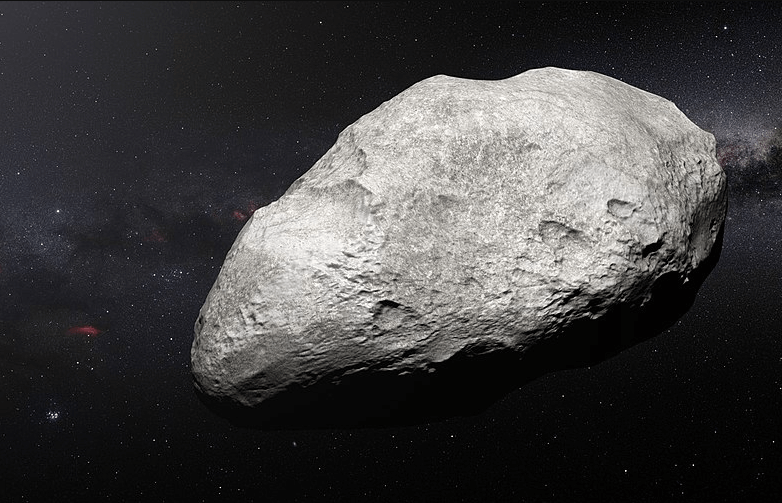 Artist's impression of the ejected asteroid 2004 EW95. Credit: ESO, Wikimedia Commons
To create at least some gravity,In theory, you could potentially "take" a huge asteroid and "spin" it like a ring station, using centrifugal force to create that 0.3g. Then build a city completely inside the rotating object. According to scientists, the stone will protect people from harmful cosmic radiation. This might work if the asteroid was made of a harder rock with a high tensile strength.
But another problem is thatMost asteroids are made of rocks that are not hard enough, at least in the solar system. The study found that most of them are “giant rubble piles”—clusters of rocks of varying sizes weakly held together by mutual gravity. If you spin such an object, it will break into pieces.
There is a solution
As a result, scientists took a different look at thisa pile of space debris. Their response is to stuff it into a “giant bag.” Scientists imagined a cylindrical bag slightly larger than the asteroid itself, made from a flexible, ultra-light and ultra-strong mesh of carbon nanofibers. This, according to lead author and PhD candidate Peter Miklavcic, would be suitable for creating extraterrestrial habitats.
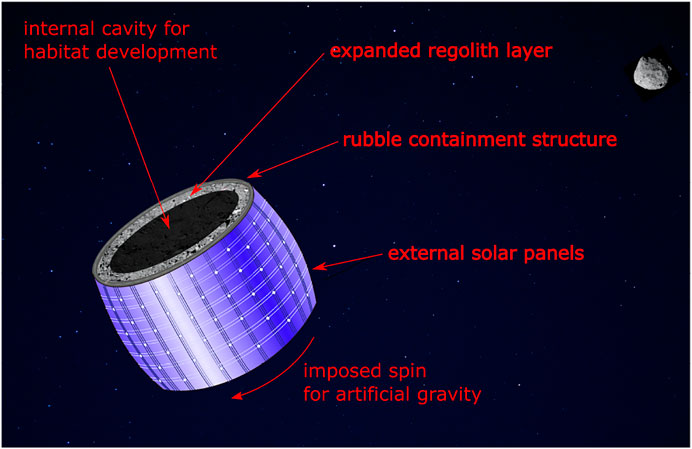 Cylindrical rotating habitat,covered with solar panels. Inside is a thick layer of asteroid rubble and regolith that protects against radiation. Directly below the solar panels is a strong, rigid container that prevents debris from flying around. The habitat rotates around its longitudinal axis, creating gravity on the inner surface.
Source: Frontiers
As an example, scientists simulated the processaround a small asteroid similar to Bennu, with a radius of 300 m. The plan is to use a nanofiber bag with an initial radius sufficient to envelop the asteroid, but designed to expand to a radius of about 3 km, and with built-in energy-absorbing compensators.
Then scientists propose breaking the asteroid intopieces and turn it inside out. The researchers decided that this could be possible by using guns that run on solar energy. They must be attached to the outer surface of the protective net. They will capture pieces of asteroid debris using conveyor belts or Archimedes screws. And then - throw them tangentially into space, creating a torque.
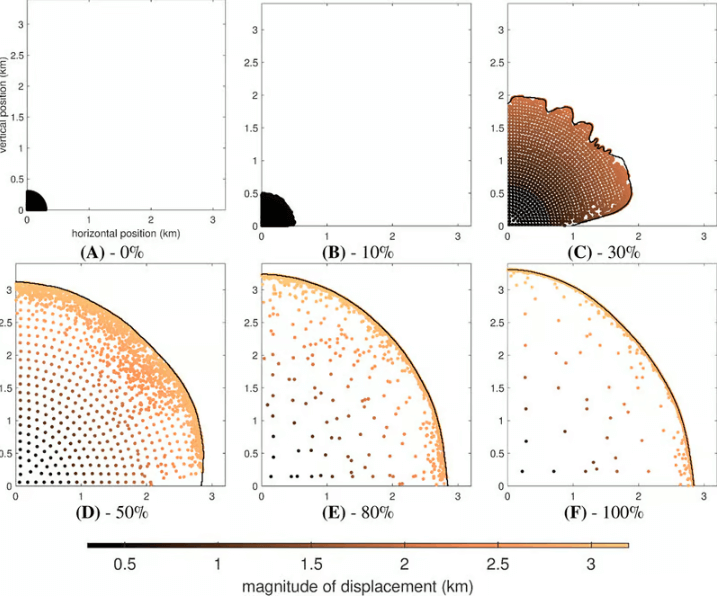 As the asteroid spins faster and faster, its rubble will be thrown outward, filling and expanding the bag of nanofibers. Credit: University of Rochester
As the asteroid spins faster and faster, its rubble will be thrown outward, filling and expanding the bag of nanofibers.
How will it look like?
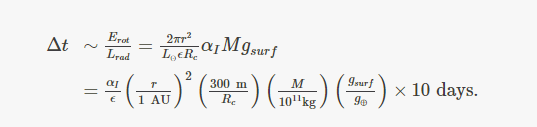
Depending on various parameters (amountsolar energy, guns and pieces of rubble), the team created a formula. It shows how long it will take to spin the asteroid material to the desired state and at what speed to achieve useful artificial gravity. The formula looks like this:
 Source: Frontiers
For example, an object the size of Bennu can be accelerated within a few months.
Based on scientists' calculations, the asteroidwith a diameter of 300 meters can thus be “expanded” into a cylindrical space habitat with a living area of about 56.9 km². It's roughly the size of Manhattan. In this case, the stress acting on the carbon nanofiber mesh will be within the range of many existing building materials today.
This results in a cylindrical rotating mediumhabitat covered with solar panels. Inside is a thick layer of asteroid rubble and regolith that protects against radiation. Directly below the solar panels is a strong, rigid container that prevents debris from flying around. The habitat rotates around its longitudinal axis, creating gravity on the inner surface.
What's the bottom line?
After calculations, scientists came to the conclusion thatturning asteroids inside out in nanofiber mesh bags is indeed a feasible way to lay the foundation for a space city. As it turns out, this is much cheaper and easier than launching construction materials from the Earth.
Read more:
17-year-old engineer came up with a magnetless motor: it can be used in electric vehicles
Two planets have been found not far from Earth. Perhaps they are inhabited
A unique meteor rewrote the history of the solar system: where did it come from
Cover photo courtesy of the University of Rochester