Astronomers from Monash University have published new near-infrared images of HD 169142.
The research team used dataThe Very Large Telescope (VLT) in Chile to study HD169142, which is more than 350 light-years away and surrounded by a protoplanetary disk.
“Planets are usually hot during their formation.Therefore, the telescope observed HD 169142 in the near-infrared. The goal is to look for signs of planet formation around a star,” explains Ian Hammond from Monash University’s School of Physics and Astronomy, lead author of the study.
The spectrum of images suggests that the planetsurrounded by a large amount of dust, which reflects starlight. This can be expected if the planet is buried under a significant amount of dust accumulated from the disk. The researchers also discovered that the planet was cutting a gap (a ring-like structure) into the disk as it pulled material from the disk itself.
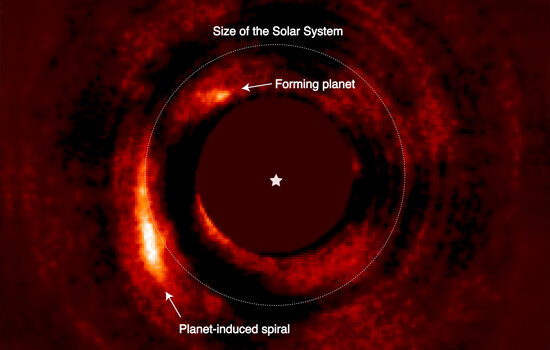 Image Credit & Copyright: Ian Hammond, Monash University, using data from ESO VLT/SPHERE
“We discovered a protoplanet at approximately 37 AU. (slightly further than the orbit of Neptune) from the star and it rotates around it at the expected speed determined by Kepler’s third law,” the scientists write.
According to Kepler's third law, the squares of the orbital periods of planets around a star are proportional to the cubes of the semimajor axes of their elliptical orbits.
This confirms previous observations in whichtalked about the preliminary discovery of a protoplanet. The new study confirms the hypothesis using re-analysis of the data and new, better quality images.
Read more:
It turned out that photosynthesis does not work the way scientists thought. Now they want to hack it
Distant radio galaxy turned out to be a black hole, which is directed directly at Earth
Found a way to reduce weight and blood sugar. Scientists promise the effect of surgery
On the cover: A disk of planet-forming dust orbits a young star.
Credit: NASA/JPL-Caltech/T. Pyle (SSC)