Astronomers analyzing data from the VLA Sky Survey (VLASS) have discovered one of the youngest neutron stars ever -
Studying the characteristics of VT 1137-0337, astronomersFor a long time they could not understand what kind of object it was and how it appeared. They concluded that it is a nebula fueled by a pulsar wind with a neutron star inside. It was created when a star much more massive than the Sun exploded as a supernova, leaving behind a neutron star. Most of its original mass was ejected outward. The neutron star spins rapidly, and when its powerful magnetic field permeates the surrounding space , it accelerates charged particles, causing strong radio emission. They rotate around the pulsar at a speed close to the speed of light.
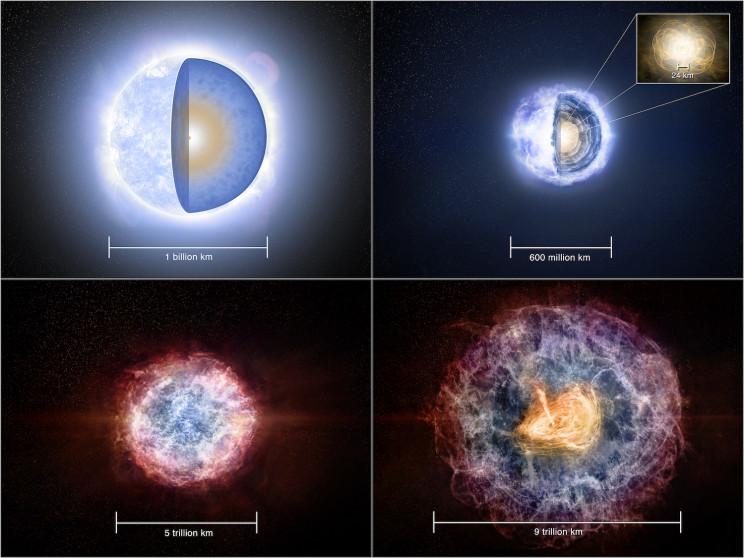 Top left to bottom right: massive star before supernova;
the same star shortly after collapse;
star shortly after a supernova;
the neutron star and surrounding debris, which has now expanded enough to allow radio emission to pass through.
Source:
Melissa Weiss, NRAO/AUI/NSF
The most famous example of a nebula that is fueled by a pulsar wind is the Crab Nebula in the constellation Taurus, the result of a supernova explosion in 1054.
The object, named VT 1137-0337, is located indwarf galaxy 395 million light-years from Earth. It first appeared in a VLASS image taken in January 2018. It did not appear in the 1998 VLA FIRST Survey image of the same region. However, it has been observed in 2018, 2019, 2020 and 2022.
“Judging by its characteristics, this is a very youngpulsar - perhaps only 14 years old. Either way, he's no older than 60 to 80 years old,” said Gregg Hallinan, Dong's PhD advisor at Caltech. The scientists reported their findings at a meeting of the American Astronomical Society in Pasadena, California.
Read more
The Japanese dumped a giant turbine into the ocean to get endless energy from the current.
Astronomers from Japan have found an unknown structure in the galaxy
Researchers filmed a 'hidden' ecosystem in an Antarctic river