Scientists have noticed that some of Neptune's Trojan asteroids are dark red in color. Their color
“In our new work we have more than doubleda sample of Neptune's Trojans studied with large telescopes," explains Bryce Bolin, an astronomer at NASA Goddard Space Flight Center and lead author of the study. The scientists synthesized data collected by four telescopes—the Palomar Observatory telescope in California, the Gemini North and South telescopes in Hawaii and Chile, and the Keck Telescope in Hawaii—over two years. The researchers tracked 18 Neptune Trojans and analyzed their color. They found that most of them were significantly redder than most asteroids. Four of them were a rich red-raspberry color.
The red-crimson color indicates thatNeptune's Trojans are rich in volatile compounds such as ammonia and methanol, scientists explain. Ice made from these chemicals is very sensitive to heat and quickly turns into a gas when exposed to enough solar radiation. Therefore, astronomers believe that asteroids located closer to the star will be paler; their ammonia and methanol have already evaporated. Scientists have concluded that some of Neptune's reddest asteroids formed even further away from the star in the solar system's early days before migrating inward and ending up in the planet's orbit.
The Trojans are a cloud of asteroids,whose orbit around the Sun is parallel to the orbit of Neptune. They are found at gravitationally stable points between a gas planet and the Sun, or between Neptune and the dwarf planet Pluto. They were first discovered in 2001; to date, less than 50 of these rocky bodies have been described.
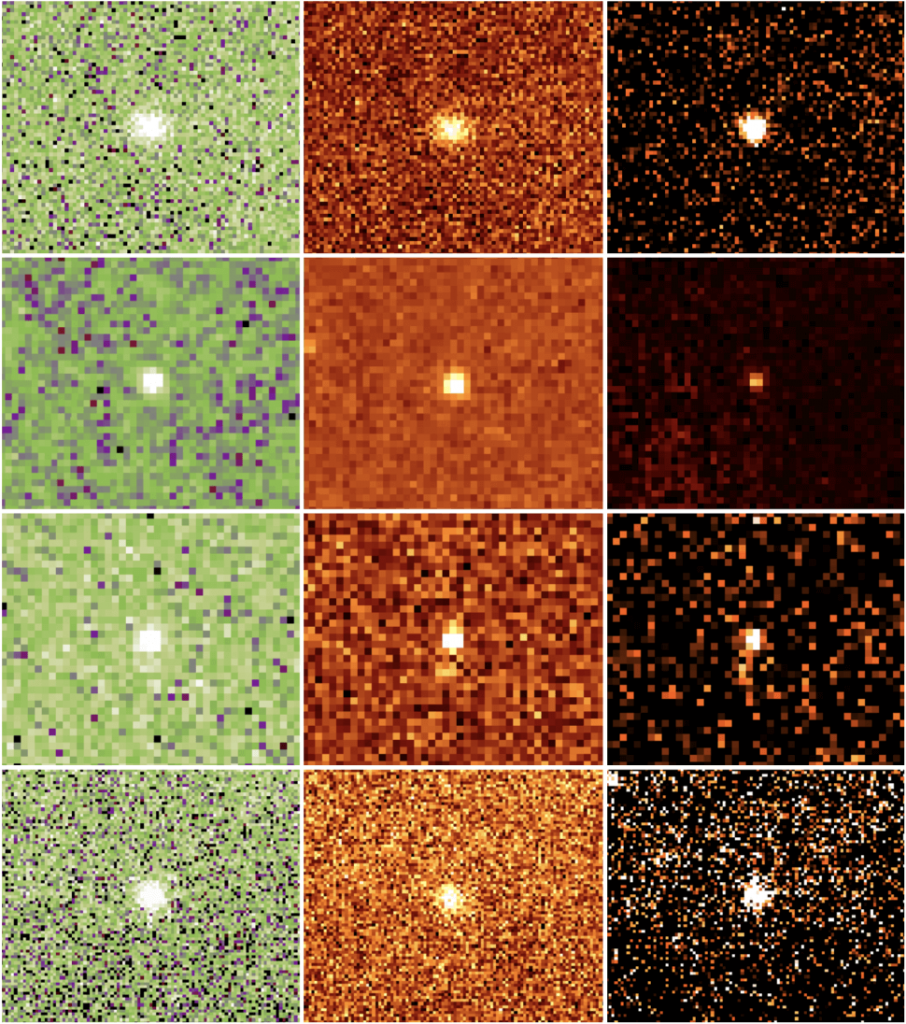 Multichannel images of Neptunian Trojans2015 VW165, 2014 QO441, 2014 YB92 and 2014 SC374 taken with the Palomar, Gemini and Keck 200-inch telescopes. View in full resolution at the link. Photo: Bryce Bolin
The reason is not that Neptunian Trojans are rare.They are difficult to detect due to their small size and long range, according to NASA. Their diameter is typically between 50 and 100 km and the space rocks orbit at a distance of 4.5 billion km from the Sun. Before the recent study, astronomers had studied only a dozen such asteroids.
Read more:
It turned out that photosynthesis does not work the way scientists thought. Now they want to hack it
Distant radio galaxy turned out to be a black hole, which is directed directly at Earth
Found a way to reduce weight and blood sugar. Scientists promise the effect of surgery
Cover: Asteroid belt, art by ESO/M. Kornmesser
</ p>