A new study published in the journal Nature Espaillat sheds light on what forces were at work when
Katherine Espilat, lead author of an article fromBoston University explains that when a baby star forms, it absorbs dust and gas particles that swirl around it in a protoplanetary disk. Particles hit the surface of the star during accretion.
Protoplanetary disks are insidemagnetized molecular clouds. They are found throughout the universe and are known to astronomers as a breeding ground for the formation of new stars. Previously, scientists assumed that protoplanetary disks and stars are connected by a magnetic field, and particles move along it to the star. When they hit the surface of a growing star, very hot and dense spots are formed during accretion.
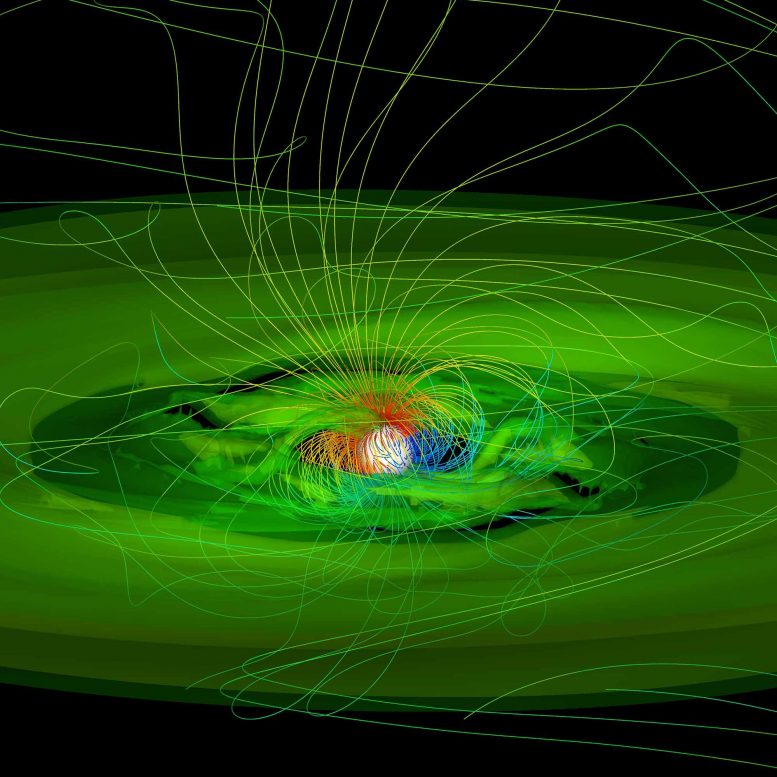 This image shows a young star ponamed GM Aur, absorbing particles of gas and dust of the protoplanetary disk, which is represented by green matter surrounding a bright star. Credit: Image of M.M. Romanova.
Observations of a young star in a distance of about450 million light-years from Earth confirms for the first time the accuracy of accretion models developed by astronomers to predict the formation of hot spots. Until now, computer models have only been based on algorithms. They calculate how the structure of magnetic fields directs particles from protoplanetary disks to hit specific points on the surface of growing stars. The observed data now support these calculations.
In the study, astronomers studied a young starGM Aur, which is located in the Taurus-Auriga molecular cloud of the Milky Way. They took pictures of the wavelengths of light emitted from the surface of GM Aur, collecting data sets of X-ray, ultraviolet (UV), infrared and visual light every day for a month.
GM Aur makes a full rotation in about oneweek. During this time, brightness levels will increase and decrease. However, after comparing the data, scientists saw a shift in the data by a day. All wavelengths of light did not peak at the same time. UV light was brightest about a day before all other wavelengths reached their peak. At first they thought they might have collected inaccurate data. But they double-checked the data and realized that this was not an error. The unusual hot spot is not completely uniform. Inside it there is an area that is even hotter than the rest.
A new study has shown that hotspots arethese are traces on the surface of a star created by a magnetic field. Once upon a time there were the same formations on the Sun. Unlike sunspots, which are colder than the rest of its surface, hotspots are found in regions where a young star absorbs particles from the surrounding protoplanetary disk of gas and dust.
To read Further
See a heavy attack drone that carries a ton of weapons
Scientists have been unable to catch Rambo's fox for three years. It prevents rare animals from being released into the forest.
A spaceship several kilometers away: everything that is known about China's new project