The European Space Agency announced the results of the Asteroid Hunter project. 11.4 thousand
ESA specialists used data fromvolunteers to train the AI that completed the image analysis. As a result of the joint work of volunteers and a neural network, scientists discovered 1701 tracks on 1316 Hubble images.
“Because of the orbit and motion of Hubble itself, the bands onThe images appear warped, making it difficult to classify asteroid trails—or, more accurately, it makes it harder for a computer to learn to recognize them automatically, says Shandor Kruk, lead researcher at the Institute for Extraterrestrial Physics. Max Planck. “That’s why we needed volunteers for the initial classification, which we then used to train the machine learning algorithm.”
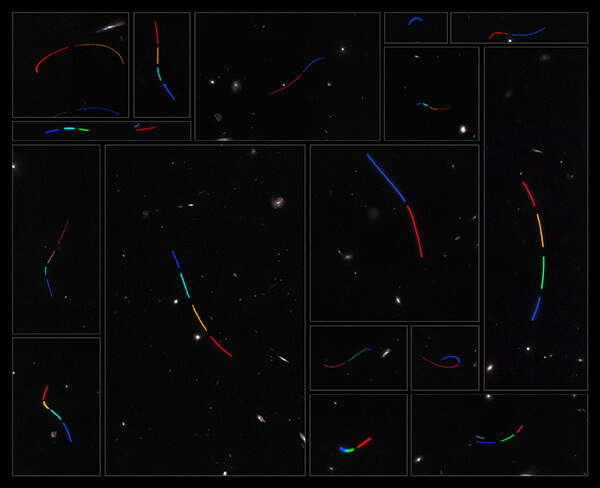 Collage of traces of different asteroids. Source: ESA/Hubble & NASA, S. Kruk (ESA/ESTEC), Hubble Asteroid Hunter citizen science team, M. Zamani (ESA/Hubble)
The researchers note that about a thirdobserved traces of asteroids can be correlated with known objects that were recorded earlier. But 1031 trails are new objects that appear to be small enough to be seen from Earth. Scientists believe that most of them will be located in the Asteroid Belt between Mars and Jupiter.
Scientists believe that analyzing data from a large number of small objects will help to learn more about the conditions in the early solar system when the planets formed.
“Asteroids are leftovers from the formation of our solar system, and we can use them to learn more about the conditions under which planets were born,” Crook adds.
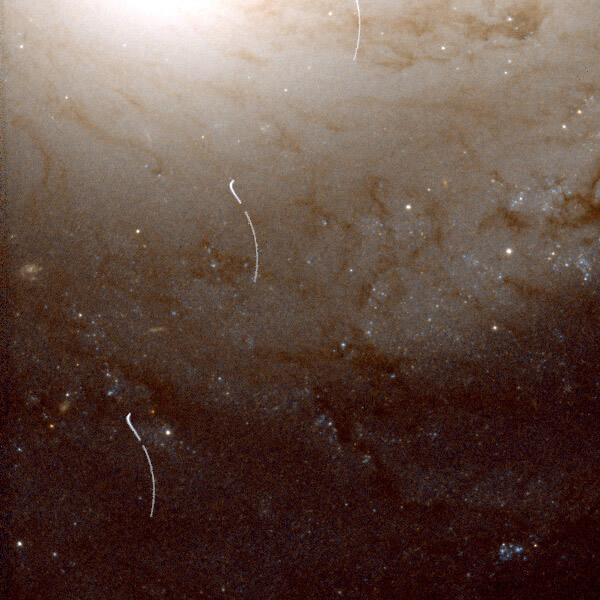 Broken track of an asteroid against the background of the galaxyVeronica's hair. The gaps are associated with the rotation of the telescope: the asteroid continued to move at those moments when the Hubble was turned in the other direction. Image: Evans and K. Stapelfeldt (Jet Propulsion Laboratory) and NASA/ESA
Cover photo: NASA, ESA, and B. Sunnquist and J. Mack (STScI)
Read more
Look at the "silent" drone with a new generation of ion propulsion
Uranus is a very strange planet. We explain why astronomers want to send a probe to it
Scientists propose to revise the foundations of quantum physics and show where they do not work