Recently, astronomers observed the eruption of a bizarre volcanic comet. She exploded like "someone in
Width of the flying comet 29P/Schwassmann —Vachmana1 (29P) is 60 km and orbits the Sun in approximately 14.9 years. In addition to its volcanic origin, 29P has an unusually circular orbit for a comet and is spinning much slower than expected. It is one of about 100 comets known as "centaurs." They “fell out” of the Kuiper Belt—a ring of icy comets hiding behind Neptune—into a closer orbit around the Sun closer to Jupiter.
In in contrast to volcanoes on Earth,which eject hot magma and ash from the planet's mantle, 29P ejects extremely cold gases and ice from the ultra-cold interior. This unusual type of volcanic activity is known as cryovolcanism or "cold volcanism."
On April 2, scientists from the BritishThe Astronomical Association (BAA) observed a sharp spike in 29P brightness caused by the reflection of light from recently ejected gas and ice, or cryomagma, in the comet's coma—the gas cloud surrounding the comet's nucleus. The eruption was likely quite significant, given that the coma dwarfed the core by more than 10 times, Spaceweather.com reports.
29P is one of the most volcanically active cometsin the solar system, and researchers have already seen it explode hundreds of times. In November 2022, there was one such event. As a result, more than a million tons of cryomagma fell into space, but scientists could not predict this.
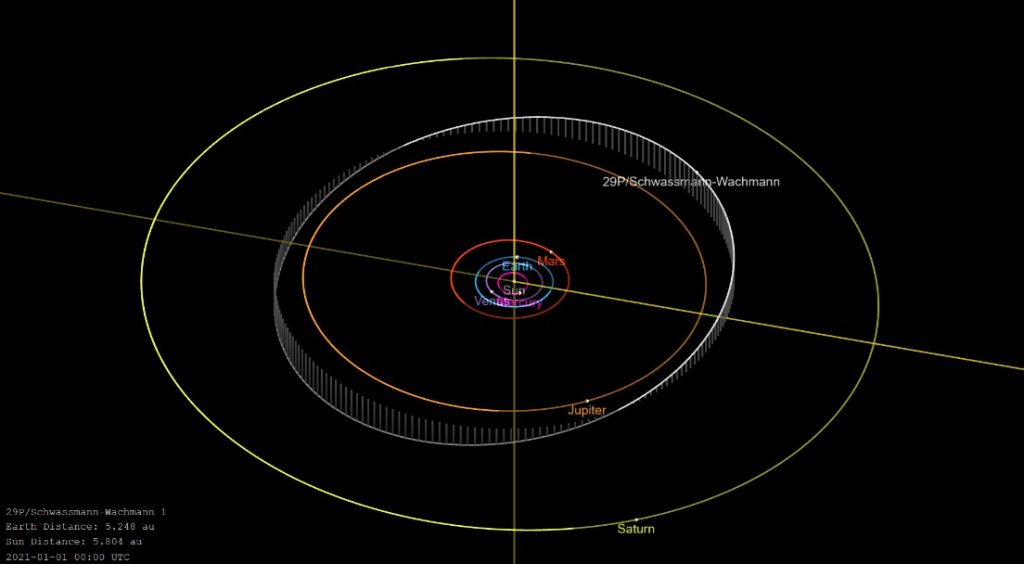 Approximately circular orbit of 29P (white) around the Sun. Image Credit: NASA/JPL Small Body Database
On April 1, British astronomersThe British Astronomical Association noted that the light surrounding the comet's nucleus was "particularly weak," the scientists wrote. This was a sign that less gas than usual was leaking from the comet's outer crust. This means that the pressure inside the comet increased at an increased speed. This made an eruption "highly likely".
The latest eruption is proof that 29P eruptions can be predicted in advance, which will help researchers study such events in more detail in the future.
Read more:
"Sea" of quarks inside one proton: what does an elementary particle consist of
Look at the highest resolution map of Mars: 110,000 frames and 5.7 trillion pixels
Scientists have studied an ultra-bright object that violates the law of physics
Cover: Infrared image of comet 29P's coma and tail after the December 8, 2003 eruption.
Image courtesy of NASA/Spitzer Space Telescope