Scientists from the University of Seville in collaboration with specialists from the University of the Basque Country in detail
Observations were carried out continuously for more than 100 days.“This was made possible thanks to the collaboration of amateur astronomers from different countries. They led a worldwide observation campaign coordinated with the Japanese Akatsuki mission in 2022,” explains Javier Peralta, a researcher at the University of Seville and a member of the mission. The results of the campaign and the scientists' findings were published in Astronomy & Astrophysics.
During the observation campaign, a UVI camera was usedThe Japanese Space Agency's (JAXA) Akatsuki mission captured ultraviolet images of the clouds of Venus. It turned out that the rupture can spread within a few hours to about 70 km above the surface of Venus. “This is surprising because until now the rupture seemed to be “locked” in the deepest clouds, and we had never observed it at such a high altitude,” explains the scientist.
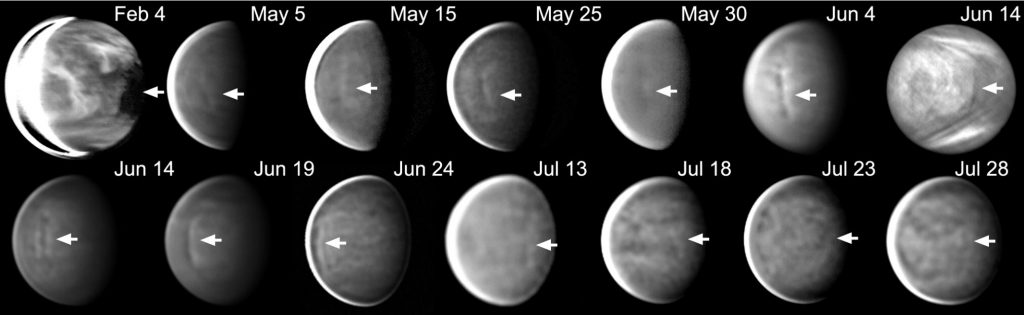 Examples of rupture events in 2022All images were processed with a high-pass filter to improve cloud detail. Credits: Astronomy & Astrophysics (2023). DOI: 10.1051/0004-6361/202244822
"Akatsuki" (Akatsuki, Japanese)"dawn", "morning dawn") is an automatic interplanetary station of the Japan Aerospace Exploration Agency (JAXA), officially known as the PLANET-C project. Intended for the study of Venus.
Astrophysicist Javier Peralta repliedfor the development of the WISPR observation strategy for Venus in 2022. He also contributed to the physical interpretation of the observations by comparing thermal emission images of the surface of Venus taken by WISPR (NASA, Parker) and the IR1 camera (JAXA, Akatsuki).
WISPR, Wide-Field Imager for Parker Solar Probe(Russian wide-angle imager for Solar Probe) is an imaging instrument as part of the Parker Solar Probe mission to the Sun, launched in August 2018. Imaging objects include visible light images of the corona, solar wind, tremors, solar emissions, etc. He also observed Venus.
Read more:
Found a way to lower blood sugar without insulin injections
Scientists believe that the shape of the universe is not what everyone thinks
NASA helicopter showed sunset on Mars. It doesn't look like earth.
Cover photo: Aster Cowart