Radio sources are various objects in the Universe that emit relatively large amounts of
Now a group of astronomers led by JoelBalzan from the University of Western Sydney in Australia reports the discovery of a new radio source, the true nature of which is still unclear. While observing NGC 2082 with the Australian Square Kilometer Array Pathfinder (ASKAP), the Australian Telescope Compact Array (ATCA) and the radio telescope Parkes, they discovered a strong point radio source. It is located 20 arcseconds from the center of the galaxy. NGC 2082 is a G-type spiral galaxy in the constellation Doradus, located approximately 60 million light-years from Earth. Its diameter is about 33,000 light years.
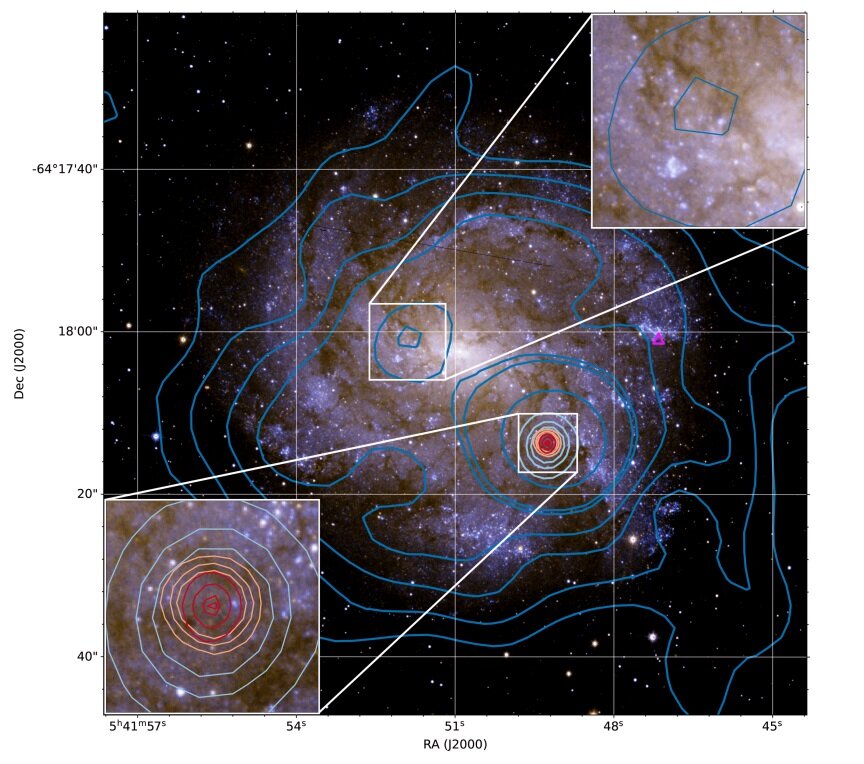 Three-color image of HST NGC 2082 with ASKAP and ATCA contours overlaid.
The inset in the lower left corner of J054149.24–641813.7 is an enlarged image showing the absence of any optical analogue. Credit: Balzan et al. 2022.
"We present observations of NGC 2082 incontinuous radio wave using the ASKAP, ATCA and Parkes telescopes in the frequency range from 888 MHz to 9000 MHz. About 20 arcseconds from the center of this nearby spiral galaxy, we detected a bright and compact radio source J054149.24–641813.7 of unknown origin,” the researchers wrote in the paper.
The study showed that radio luminosityJ054149.24–641813.7 at 888 MHz is at 129 EW/Hz and has a flat radio spectral index (about 0.02). This, according to astronomers, contradicts the scenario in which J054149.24–641813.7 could be a supernova remnant (SNR) or a pulsar, suggesting that the source may be of thermal origin.
The researchers noted that the compactness of J054149.24–641813.7 and its location on the outskirts of NGC 2082 are reminiscent of some fast radio bursts (FRBs). However, the results indicate that J054149.24–641813.7 is likely not bright enough to be a persistent radio source with an embedded FRB precursor.
Astronomers concluded:the most likely remaining possibility is that J054149.24–641813.7 is an extragalactic background source, such as a quasi-stellar object (QSO, quasar), radio galaxy, or active galactic nucleus (AGN). They added that the flat spectral index, together with the somewhat weak polarization at 5500 and 9000 MHz, supports this hypothesis. However, there are currently no high-resolution neutral atomic hydrogen (HI) absorption data for NGC 2082 that could support this assumption.
Read more
Monkeypox is becoming a global virus: why it is transmitted so quickly
Something strange is happening in the Universe: how to explain inconsistencies in the Hubble constant
Diagnosis in a minute: how IT is changing healthcare