Astrophysicists from Northwestern University and the University of California at San Diego have discovered the most
LP 413-53AB is a star system thatformed several billion years ago at the same time as the Sun. It consists of two ultra-cool dwarfs. These are very low-mass stars that are so cool that they emit their light primarily in the infrared. Such stars are invisible to the human eye, but at the same time they are among the most common in the Universe.
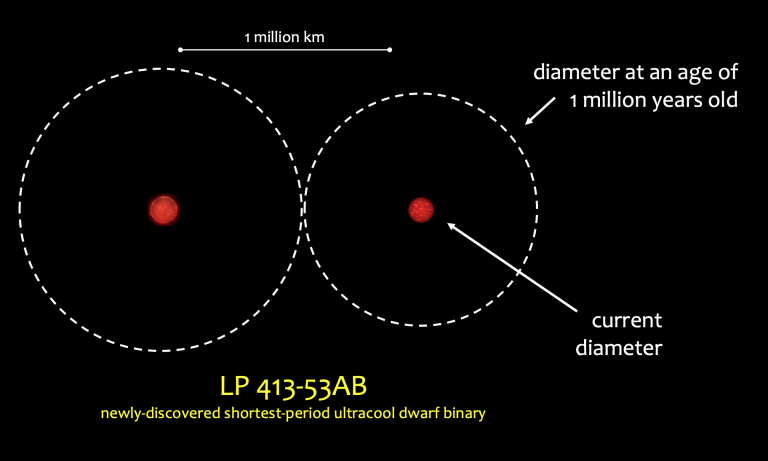 An illustration of the current size of the stars in the LP system413-53AB and distances between them. It is the oldest and most "close" binary system discovered to date. Image: Adam Burgasser/UC San Diego
Researchers have discovered an unusual system whenstudy of archival data. They used an algorithm that models a star based on its spectral data. By analyzing the radiation spectrum, this algorithm determines the chemical composition of the star, its temperature, gravitational properties and rotation speed.
Initially, researchers hypothesized thatthe observation area contains a single star, since the spectra of nearby stars actually merged. However, a deeper analysis revealed the presence of two separate objects, closely connected into a single system: the distance between the two stars was about 1% of the distance between the Earth and the Sun.
Most of the binary systems that wefollow, have a period of circulation in years. So you get measurements every few months. Then, after a while, you can complete the puzzle. In this system, we observed how the spectral lines diverge in real time. It's amazing to see something happening in the universe on a human time scale.
Adam Burgasser, professor of astrophysics at the University of California, San Diego
Read more:
The mystery of the red stripes on the satellite of Jupiter is revealed
Found "impossible" planet. She defies modern science
Archaeologists have found an ancient Roman analogue of barbed wire
On the cover: an artistic illustration of a cold dwarf star. Image: NASA/JPL-Caltech