A team of researchers led by Sean Marshall, a planetary scientist at the Arecibo Observatory in Puerto Rico,
Using data from space observations"stone" from 1989 to 2021, scientists built a model to determine the shape of Phaeton in preparation for the mission. To the surprise of the researchers, the results of the simulation did not match the latest observations: the times when the object in the model glowed brighter did not coincide with the actual change in the luminosity of the asteroid.
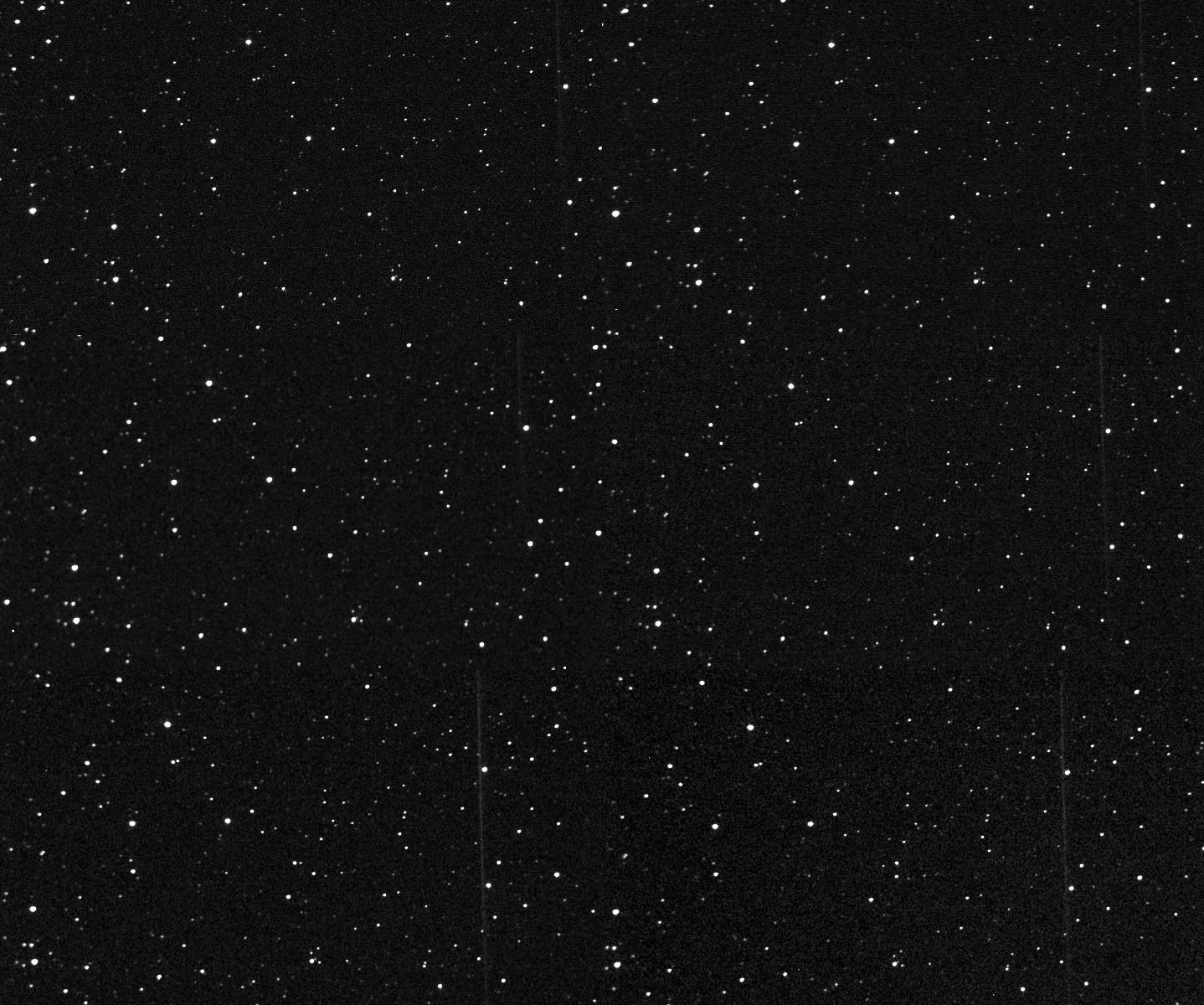 Asteroid Phaeton in 2017. Image: Kobalts, CC BY-SA 4.0 via Wikimedia Commons
The researchers hypothesized that it couldexplained by the fact that Phaeton's rotation period changed slightly some time before the 2021 observations. The most likely cause: comet-like activity during the passage of perihelion (the point of the orbit closest to the Sun). The fact is that the asteroid is approaching our star at a distance of up to 21 million km - twice as close as Mercury.
The researchers found that the bestreal observations describe a model in which the rotation period decreases by 4 ms per year. The researchers note that although more than a million asteroids have been discovered to date, including over 30 thousand near-Earth objects, Phaeton is only the eleventh example of a change in the rotation speed among asteroids. In addition, he is the largest of them.
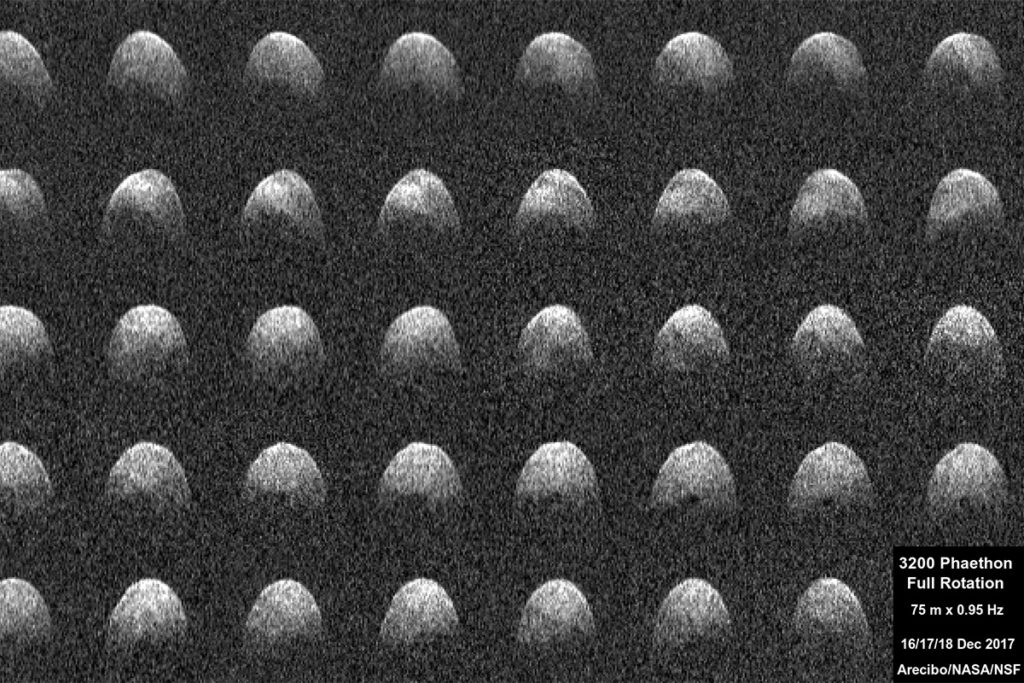 Doppler images of Phaeton with a delay,obtained using the planetary radar system of the Arecibo Observatory in December 2017. Image: Taylor et al. 2019, Planetary and Space Science
Phaeton is a near-Earth asteroid with an averageabout 5.4 km in diameter. Although current simulations indicate that the risk of this object colliding with Earth is minimal, a small change in the orbit of such a large object could potentially lead to a dangerous collision in the future.
Japan Aerospace Exploration Agencyplans to send the DESTINY+ mission to the near-Earth asteroid Phaeton in 2024. The spacecraft will have to fly up and, possibly, land on the object four years later - in 2028. The refined model of the object's rotation will help researchers understand which regions will be illuminated by the Sun during the passage of the spacecraft and better plan the mission.
Read more:
Living organisms have made Mars uninhabitable
The most powerful black hole collision in the universe proved Einstein's theory
The bones in the Midnight Terror Cave were carefully examined and found inexplicable footprints.
On the cover: Artistic illustration of an asteroid approaching Earth