Researchers observed the repeating fast radio burst FRB 20201124A (English Fast Radio Bursts) and recorded about 1
According to the study, FRB 20201124A may be analogous to pulsed emissions from the galactic binary PSR B1259-63/LS 2883, which contains PSR B1259-63 and the Be star LS 2883.
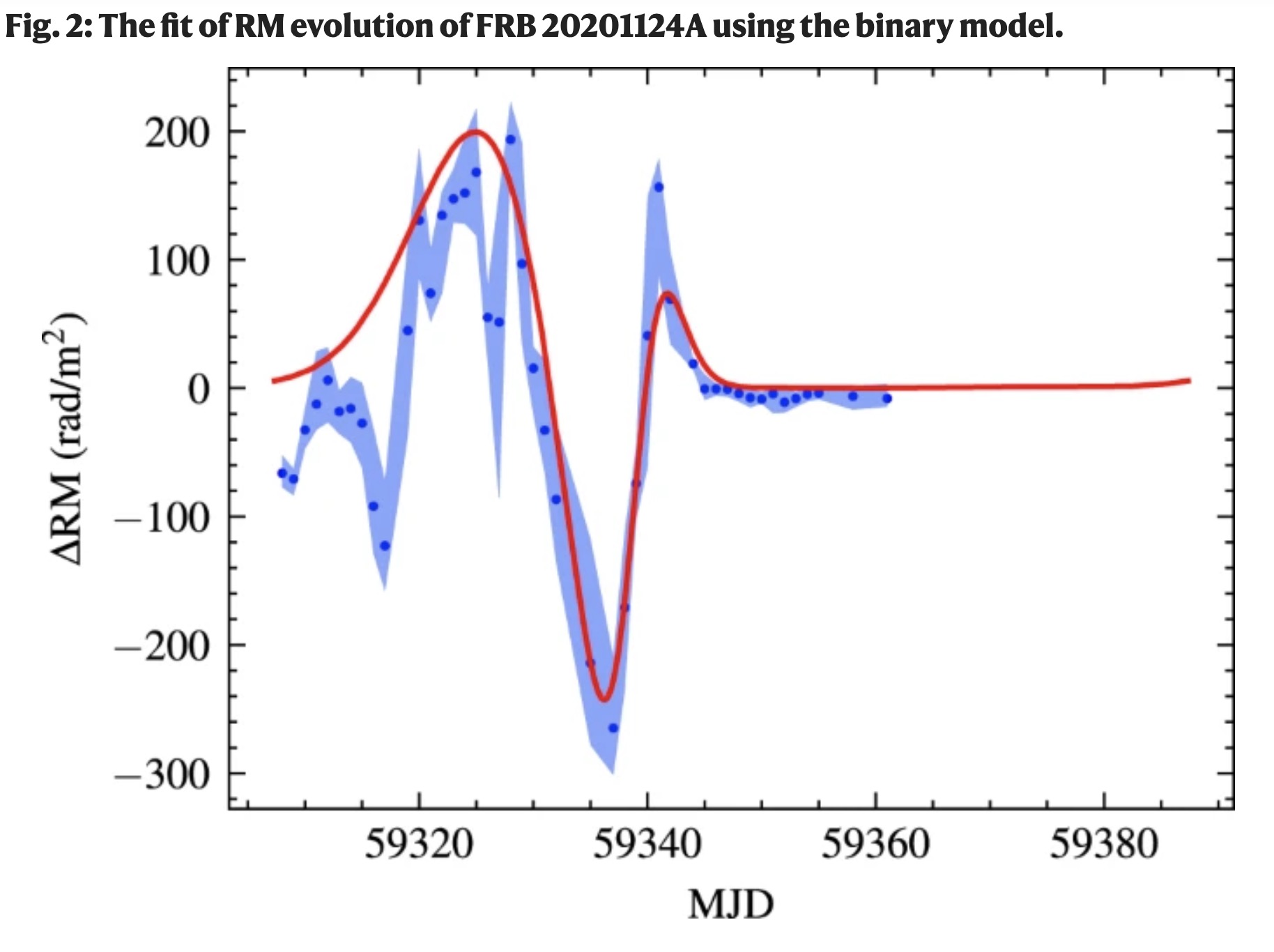 An illustration of the correspondence to the evolution of RM FRB 20201124A using a binary model. Photo: Nature
Fast radio bursts - detectableradio telescopes, single radio pulses lasting several milliseconds of unknown nature. A typical burst energy, assuming isotropic radiation, is equivalent to the release into space of the energy emitted by the Sun over several days.
Although hundreds of FRBs have been discovered, their physical nature remains unclear.
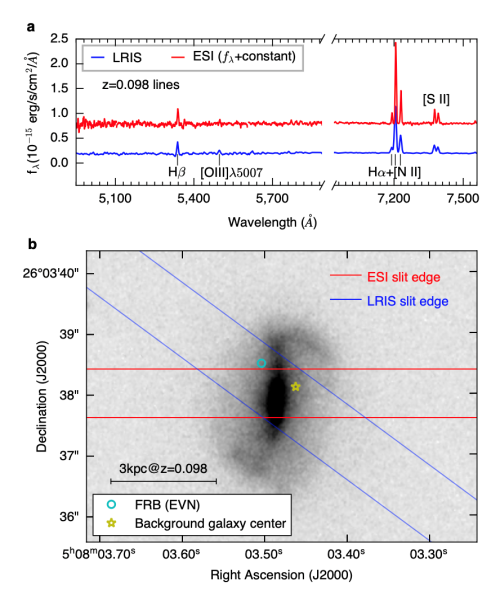 Spectral and high-resolution images of the host galaxy FRB20201124A using the Keck Telescope. Photo: Nature
In a new study, scientists presenteda physical model that explains the observed characteristics of FRB 20201124A. They suggested that the repeating signal comes from a binary system containing a magnetar and a Be star with a decrement disk.
Recall that Be stars are very hot objects.spectral class B with an effective temperature of 10,000 to 30,000 K (9,726.85 °C–29,726.85 °C) and luminosity of class III to V. Their spectrum shows at least one emission line - typically , Balmer series of hydrogen.
A study conducted by researchers fromNational Astronomical Observatory of China (NAOC) of the Chinese Academy of Sciences (CAS) and Peking University, published in the international academic journal Nature.
Read more:
Mysterious 'blue goo' at the bottom of the sea baffles scientists
Developed generator for wind farms without expensive magnets
Look at a phenomenon that is simply impossible on Mars