An international team of researchers using the FAST spherical telescope in China discovered that the Quintet
"This is the largest gas structure everdiscovered around a group of galaxies,” said Xu Cong, a specialist from the National Astronomical Observatories of the Chinese Academy of Sciences and lead author of the new study.
According to the researchers, this discovery will requirefrom astronomers to rethink the behavior of gas at the edges of galaxy groups. Because hydrogen moves more freely through galaxies than other components of the cloud of gas, it is easily dispersed when objects in the galaxy interact with each other. The scattered hydrogen in Stefan's quintet is a "time capsule" that can tell scientists about such events that happened about a billion years ago.
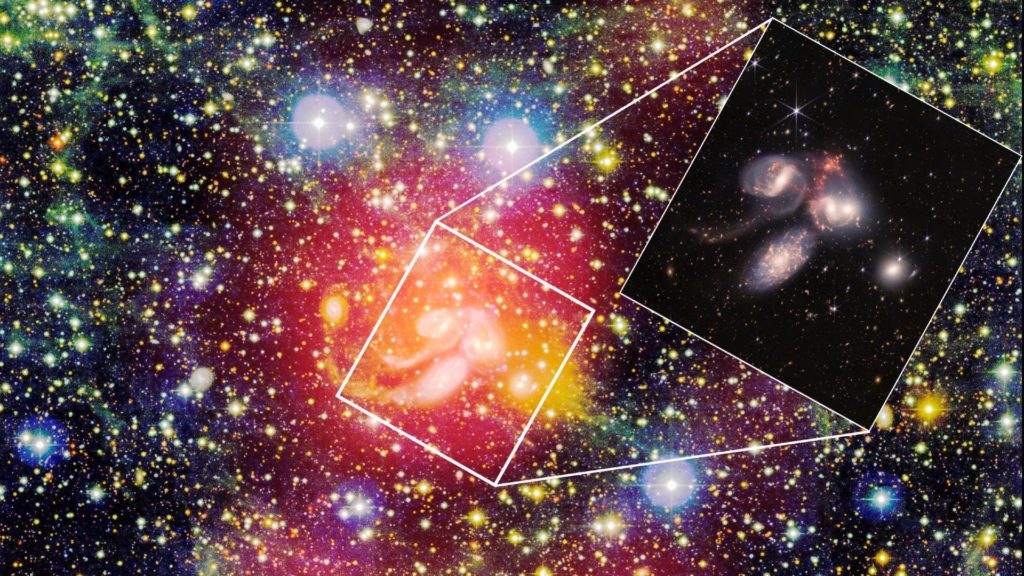 Gas in Stephen's Quintet
Astronomers expected that ultraviolet lightwill change the nature of the hydrogen in the cloud. The ultraviolet light ionizes the atoms in the atomic gas cloud, meaning they will gain or lose electrons and end up charged. But the gas observed in Stefan's quintet is somehow not ionized.
The absence of ionization indicates that this gascould have remained after the formation of the galaxy. Away from stars, diffuse clouds of atomic hydrogen still exist on their own, which could argue that they are a by-product of the interaction that formed the galaxy. It is also possible that the cloud surrounding Stephan's Quintet may have been ejected from an ancient collision between two galaxies.
So far, researchers do not know exactly how this gas originated. But the answer to this question can change the idea of how galaxies are born and develop.
Read more:
Archaeologists have officially confirmed the legends from the Bible
The grave of the "priestess" of Aphrodite was found: scientists showed what they found there
Scientists have seen what is on the territory of the Mayan capital. The find surprised them.