Astronomers from the European Space Astronomy Centre in Madrid, Spain, analysed Swift data
Astronomers also estimated the strength of the magnetic field based on the deceleration of rotation during the off state between 2017 and 2019 and found that it is at the level of 25 trillion gauss.
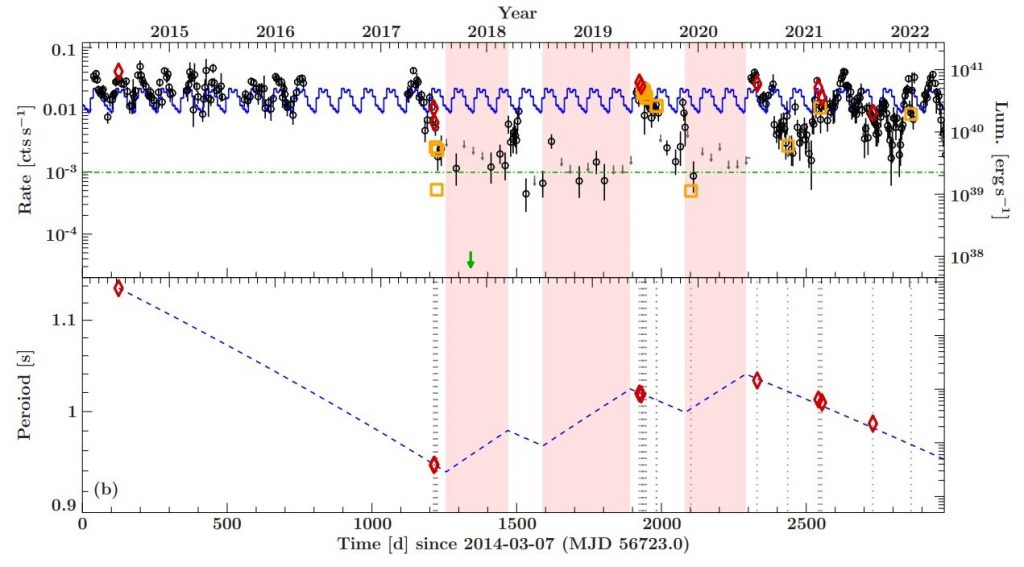 Evolution of NGC 5907 ULX1 from 2014 to 2022. Credit & Copyright: Furst et al., 2023
Ultraluminous X-ray sources (ULX,Ultra-luminous X-ray sources are point sources in the sky that are so bright in X-rays that each one emits more radiation than a million Suns emit at all wavelengths. Although they are less luminous than active galactic nuclei, they are more stable than any known stellar process.
Maximum luminosity of NGC 5907 ULX1reaches 100 duodecillion erg/s. It is the brightest ULXP star discovered to date. It is located approximately 56 million light-years from Earth in the Knife Edge Galaxy (also known as NGC 5907). NGC 5907 ULX1 has a rotation period of approximately 1.14 seconds. The object is also known for its rapid rotation when "on". However, very little is known about the magnetic field of this pulsar.
Astronomers generally believe that becausetheir brightness, most ULXs are black holes. However, recent observations have shown that some ULXs exhibit coherent pulsations. These sources, known as ultraluminous X-ray pulsars (ULXPs), are neutron stars that are typically less massive than black holes. Scientists have not discovered many ULPs, so each such find is a rarity.
Read more:
A powerful flare erupted on the Sun: it has already affected the Earth
Medieval fortress accidentally discovered in the forest: the find surprised scientists
Scientists have found a new genetic disease in children: how it manifests itself
On the cover: an artist's vision of ULX
Credit: NASA / JPL-Caltech