The strong gravity that comes from a cluster of galaxies causes space to bend so much that
 Credit: Peter Laursen
Scientists obtained images of the supernova with the help ofHubble telescope. SN-Requiem exploded about 10 billion years ago, long before the Sun was formed. “The flash of light from this explosion had just reached us,” explains Associate Professor Gabriel Brammer, who led the study.
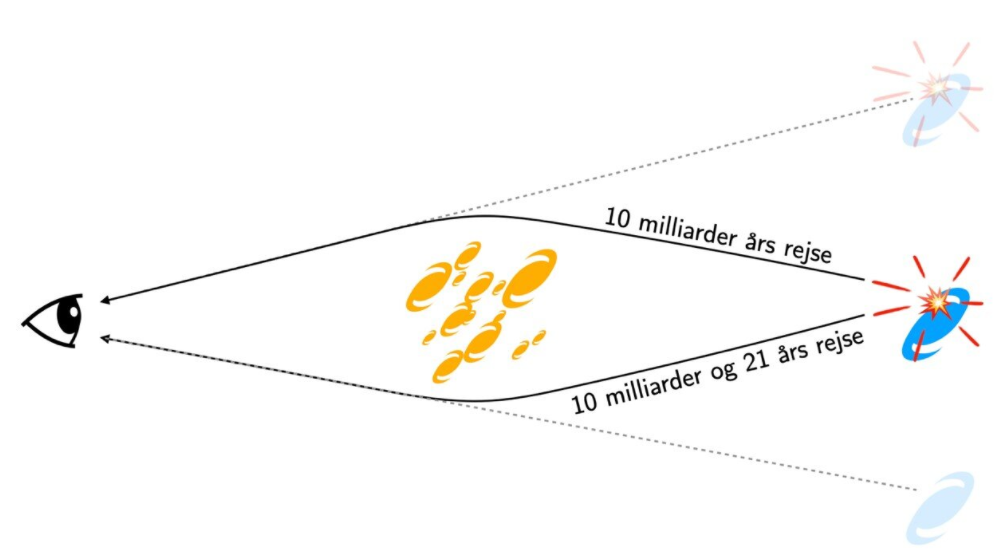 Credit: Peter Laursen
Danish scientists also predicted that in 16years - by 2037 - a fourth image of the same explosion will appear in the sky. In their work, they studied how galaxies are distributed in clusters and how images of different objects are distorted by curved space. This helped them calculate how much light from objects is “delayed.” The results of the study were published in the journal Nature Astronomy.
To read Further
The most detailed model of the Universe has been published online. Anyone can study it
Physicists come close to discovering the fifth force while creating perfect crystals
Physicists have cooled atoms to the lowest temperature in the world