The region known as the galactic halo lies outside the twisted spiral arms that
The data for the new map comes from ESA's Gaia mission andNASA's Near Earth Object Wide Field Infrared Survey Explorer - or NEOWISE, which operated from 2009 to 2013 under the name WISE. The study uses data collected by the spacecraft between 2009 and 2018.
This visualization shows the central discour Milky Way galaxy and a smaller neighboring galaxy called the Large Magellanic Cloud. The new all-sky star map shows the location of the stars in the outer reaches of the Milky Way (known as the galactic halo), from roughly 200,000 light-years to 325,000 light-years from the center of the Milky Way. NASA / JPL-Caltech
The new map shows how a small galaxy- Large Magellanic Cloud (LMC) - passed through the galactic halo of the Milky Way, like a ship through water, leaving a gravitational trail in the stars behind it. LMC is located about 160,000 light-years from Earth and is less than a quarter of the mass of the Milky Way.
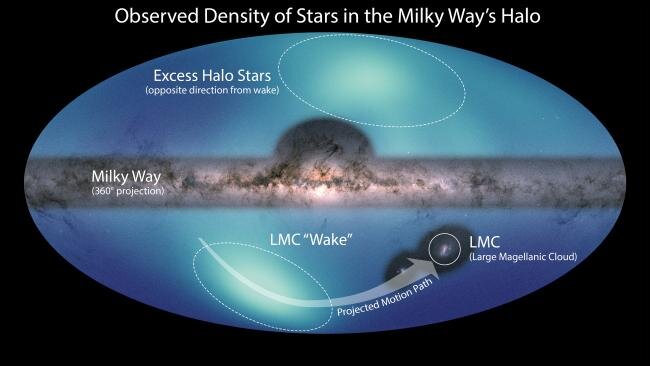
Although the inner parts of the halo are already depictedWith a high degree of accuracy, the new map is the first to give a similar picture of its outer regions - from 200,000 light-years to 325,000 light-years from the galactic center. Previous studies have hinted at the existence of a star trail, but the all-sky map confirms its presence and offers detailed insight into its shape, size and location.
Read more
The first accurate map of the world was created. What's wrong with everyone else?
Ingenuity helicopter successfully takes off on Mars
NASA told how they will deliver samples of Mars to Earth
The Large Magellanic Cloud is a dwarf galaxytype SBm, a satellite of the Milky Way, located at a distance of about 163 thousand sv. years from our Galaxy. This distance roughly corresponds to the diameter of our Galaxy. It belongs to the type of Magellanic spiral galaxies.