Analyzing data from the 104-cm Sampurnanand telescope (ST) and the European satellite
Open clusters (OCs) formed from oneand the same giant molecular cloud, are groups of stars weakly gravitationally connected to each other. To date, more than 1,000 of them have been discovered in the Milky Way, and scientists continue to search, hoping to find more of these stellar “groupings.” Expanding the list of known galactic PCs and their detailed study is crucial in the study of our galaxy.
A team of astronomers led by Apar Tripathifrom Deen Dayal Upadhyaya Gorakhpur University in Gorakhpur, India, decided to conduct a photometric and kinematic study of NGC 1027 to better understand its structural and fundamental parameters. To do this, they analyzed existing data collected by ST and Gaia.
The study found that NGC 1027 has a radius of about 8.64 light years. Astronomers also discovered that the age of the RS is about 130 million years. Therefore, the cluster is younger than previously thought.
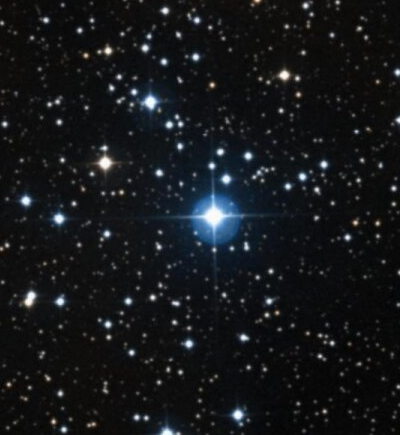 R/B color composite image of NGC 1027 from the Second Digitized Sky Survey (DSS2). Photo: DSS2
According to a new study, the distance to NGC1027 is approximately 3,700 light years away. This, in turn, is in good agreement with previous estimates. Also, analysis of the new data showed that relatively massive stars are predominantly distributed in the inner regions of NGC 1027. The authors of the paper concluded that this suggests mass segregation, and believe that the RS is influenced by external tidal interactions.
Read more:
Tumor size reduced by implanting 'edited' fat
New solar cell breaks world efficiency record
No longer a toy. What will the evolution of GPT and Midjourney lead to?
Cover photo: Heart Nebula by Adam Evans