Scientists who study the star V Hydrae (V Hydrae, V Hya) have witnessed the mysterious death throes of a star with
V Hydra is a carbon-rich star.an asymptotic giant branch (AGB star) located approximately 1300 light years from Earth in the constellation Hydra. More than 90% of stars with a mass equal to or greater than the mass of the Sun evolve into AGB stars as the fuel needed to power nuclear processes runs out.
Among the millions of stars, V Hydrae representsof particular interest to scientists due to its unique behavior and characteristics. Among them are extremely large-scale plasma emissions that occur approximately every 8.5 years, as well as the presence of an almost invisible companion star that influences the fate of V Hydra.
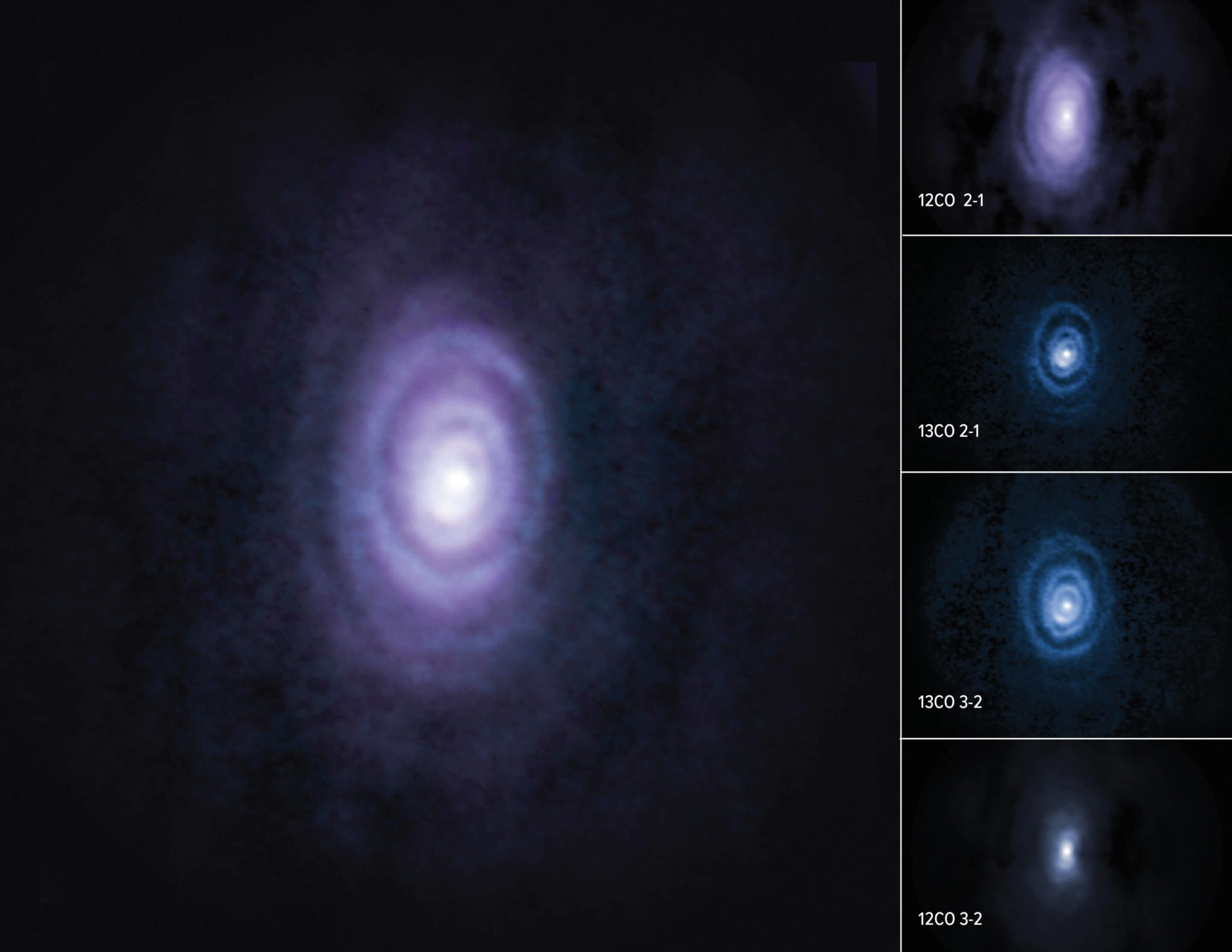 Scientists have discovered six slowly expandingrings that form as a star ejects its material. The rings shown here and the diffuse arc structure of the sixth ring are moderately visible in the 12CO carbon isotope emission line and become well defined in the 13CO carbon isotope images. Previously, scientists have observed such rings. Photo: ALMA (ESO/NAOJ/NRAO)/S. Dagnello (NRAO/AUI/NSF)
“Our study strongly suggests thatThe traditional model of how AGB stars die—due to massive ejection of fuel by a slow, relatively steady spherical wind for 100,000 years or more—is incomplete at best and wrong at worst.
Apparently, this process is influenced by stellar orsubstellar companion. Understanding the physics of double interactions is important to astrophysics and is one of its biggest challenges. “Perhaps it was she who led to the release of six rings of matter into space and the death agony of the star,” the authors of the study conclude.
Read more
The "fifth element" exists: a new experiment will confirm that information is material
Creepy sounds and mysterious creatures: the strangest finds in the Mariana Trench
Look at the best picture of the Sun: it consists of 83 million pixels
Asymptotic giant branch - late stageevolution of small and medium mass stars. Stars at the evolutionary stage of the asymptotic giant branch have low temperatures and large sizes and luminosities. Wikipedia