Using a variety of telescopes, an international team of astronomers examined IC 1396, a nearby region
Preliminary data showed that IC 1396lies between 2,830 and 3,080 light-years from Earth in the star-forming bubble of Cepheus. Its structure is a HII star-forming region because it contains clouds of ionized atomic hydrogen. The region has a fairly simple structure and is fed by the multiple star system O HD 206267, which is located near the geometric center of IC 1396 in the young Trumpler 37 cluster.
Previous observations of IC 1396 showed thatit also contains several bright-rimmed clouds (BRCs), formed by the ultraviolet radiation of HD 206267. These clouds indicate ongoing star formation and are perceived by astronomers as excellent laboratories for studying young stars in various regions. evolutionary stages.
Therefore, a team of researchers led by Mara E. Pelayo-Baldarrago from the Autonomous University of Madrid in Spain studied IC 1396 and its BRC using multi-wavelength data from various instruments.
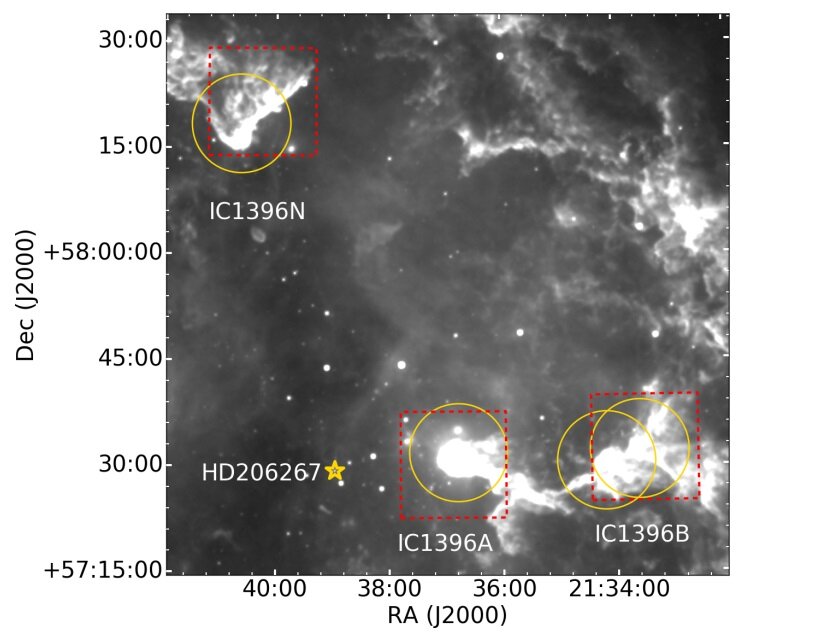 WISE W4 image (22.19 µm) of the IC 1396 HII region. BRCs are labeled with their names.
Credit & Copyright: Pelayo-Baldarrago et al., 2022
The study found that the IC 1396 regioncontains four independent subclusters (labeled A, B, E, F), differing significantly in proper motion, but not in parallax. This discovery, together with the spatial distribution of stars, suggests a complex and diverse star formation process in IC 1396.
Further examination of the four subclusters revealed that they also differed in age. It turned out that the populations on the outskirts of subclusters B and E are older (on average) than in subcluster A.
Star forming regions are essential for astronomersfor a better understanding of star formation and stellar evolution. Observations of such regions can expand the list of known stars, protostars, young stellar objects and clumps, which can then be comprehensively studied at different wavelengths to provide more information about the early stages of the stellar life cycle.
Read more:
Scientists have seen what is on the territory of the Mayan capital. The find surprised them.
An invisible sweater has been created. It will help to "escape" from artificial intelligence
Britain's oldest human DNA reveals who migrated to the country BC