Using the VLT Survey Telescope (VST), European astronomers have studied a peculiar star cluster
The age of the star cluster, also known asOHSC 37 is estimated to be approximately 2.7 billion years old. However, analysis of the color magnitude diagram of KMHK 1762 led scientists to believe that the cluster may be older.
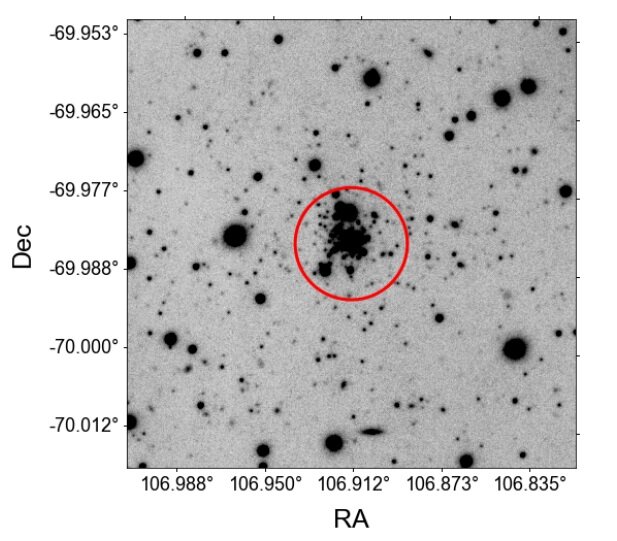 Image centered on KMHK 1762. The red circle indicates the radius of the star cluster. Author: Gatto et al., 2022
A group of astronomers led bywith Massimiliano Gatto of the Capodimonte Astronomical Observatory in Naples, Italy, suggested that KMHK 1762 is an example of a rare case of a star cluster in the so-called LMC age gap. Previous observations of the LMC have shown that this galaxy is almost completely devoid of star clusters between 4 and 10 billion years old. Within this age gap, only two confirmed star clusters have been identified so far.
Scientists analyzed deep opticalphotometry of KMHK 1762 obtained using VST as part of the Yes, Magellanic Clouds Again (YMCA) study. The study was supplemented by data from ESA's Gaia satellite.
Using finer-grained photometry data,Astronomers have calculated that KMHK 1762 is actually about 5.5 billion years old. This means that KMHK 1762 is the third star cluster in the LMC age gap, in addition to the clusters ESO121-03 and KMHK 1592.
Read more:
The supersonic plane will fly at a speed of 2,000 km/h and cross the ocean in 3.5 hours
Scientists filmed a strange creature with tentacles, which they mistook for a flower
Created a quantum computer that "went beyond the binary system"