Using the AstroSat spacecraft, Indian astronomers studied the open cluster (OC) NGC 2506. During
Open clusters formed from one andof the same giant molecular cloud, are groups of stars weakly bound to each other by gravity. To date, astronomers have discovered more than 1,000 of them in the Milky Way and continue to search. Their detailed study is of decisive importance for understanding the formation and evolution of the Galaxy.
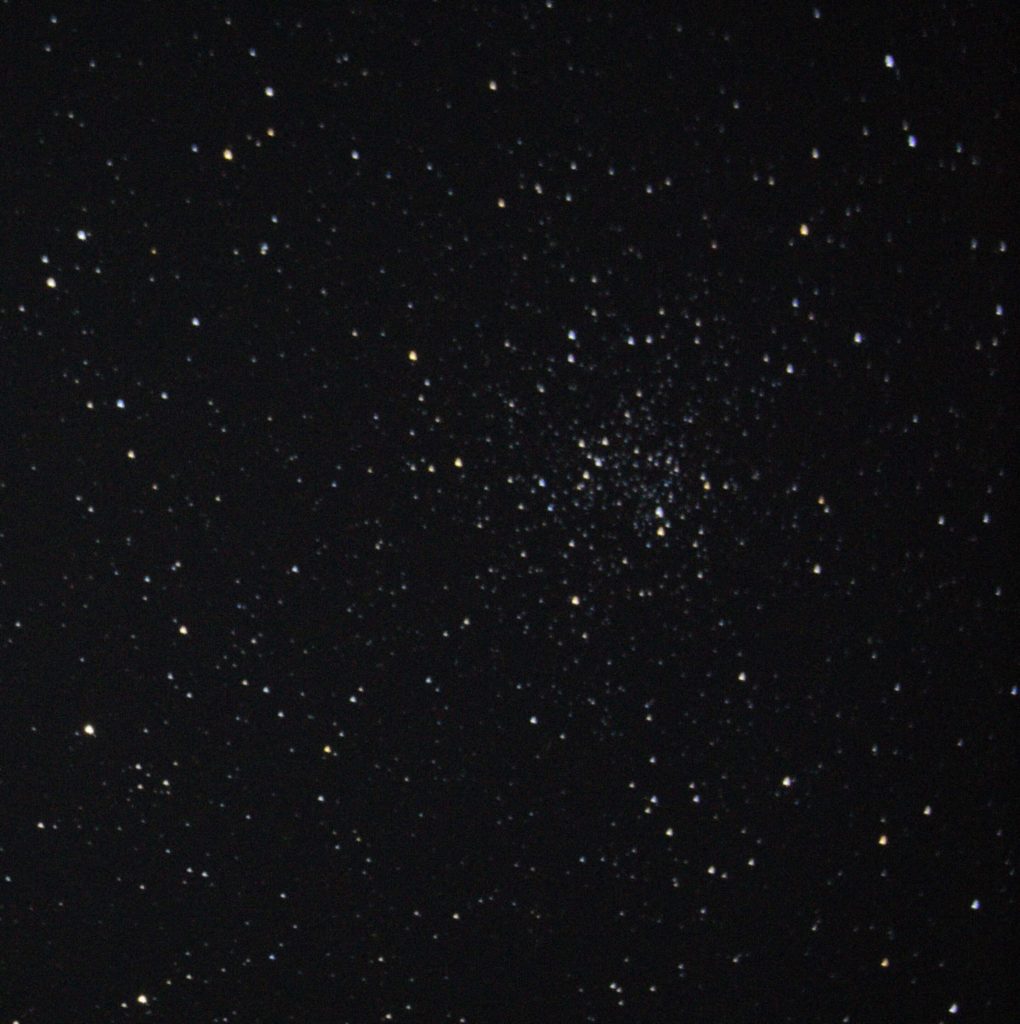 NGC 2506. Photo: StudentAstronomyGroupUoC
NGC 2506 (also known as Caldwell 54)is located at a distance of about 12,700 light years from Earth. Scientists have studied this cluster before, but still know little about its stellar composition. Previous observations have shown that there is massive segregation in NGC 2506. At the same time, stars with a lower mass are most likely located in the outer parts of the cluster.
Now Indian scientists have carried out multi-wavelengthobservations of this cluster, mainly with the UltraViolet Imaging Telescope (UVIT) aboard AstroSat. They also used archival data.
Animation of blue stugglers. Credit: ESA/Hubble & NASA, L. Calçada
In total, scientists studied 2,175 stars in the NGC cluster.2506 using an algorithm based on machine learning. Among them are nine blue stagglers (blue straggler stars, BSS), three yellow stagglers (yellow straggler stars, YSS) and three stars at the red clump stage (RC).
Effective temperatures of BSS stars in NGC 2506range from 7750 to 9750 Kelvin (7476.850 ℃–9476.850 ℃), which is consistent with the age of the cluster - about 2 billion years. The temperature of YSS stars is between 6500 and 6750 K (6226.850℃–6476.850℃) and the temperature of RC stars is 5000–5250K (4726.850℃–4976.850℃).
Read more:
The space plane will deliver cargo to the ISS and land at a regular "airport"
The star approached the black hole and it was torn apart: scientists observed this from three telescopes
Physicists explain Hawking's 'cosmic mismatch': how it will change science
Cover photo: Pleiades. NASA, ESA, AURA/Caltech, Palomar Observatory, Public Domain