Using the San Pedro Mártir Observatory and data from ESA's Gaia satellite, astronomers studied two old scattered
NGC 1798, discovered in 1885, is locatedat a distance of about 11,300 light years from Earth in the constellation Auriga. Its metallicity is at the level of −0.27, and its age is estimated at 1.7 billion years. As for NGC 1193, this PC was discovered in 1786 in the constellation Perseus, at a distance of about 15,000 light years from Earth. Previous observations indicated that NGC 1193 is approximately 8 billion years old and has a metallicity level of −0.34.
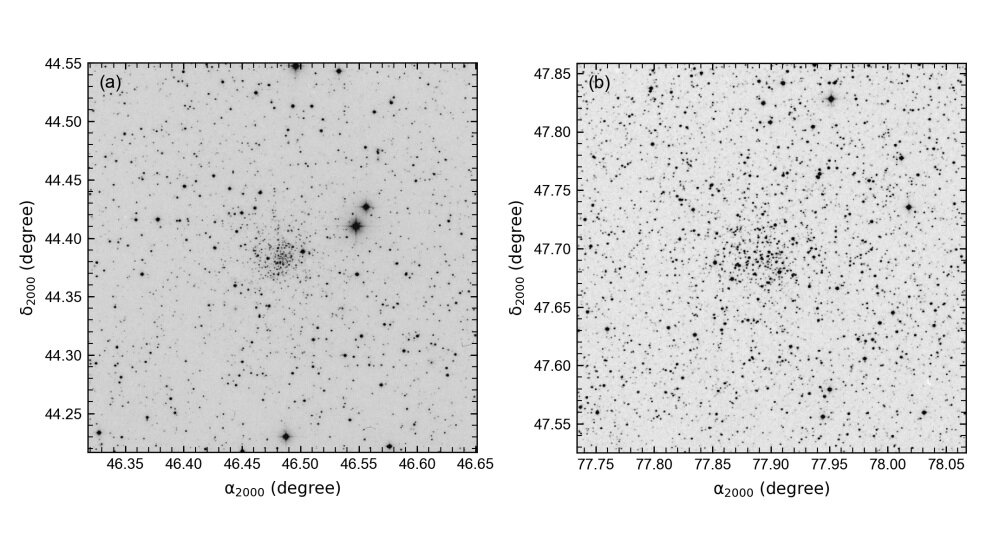 Identification cards for NGC 1193 (left panel) and NGC 1798 (right panel), taken from the Leicester Database and Archive Service. Image Credit & Copyright: Yontan et al., 2022
A group of researchers led by TalarYontana from Istanbul University in Turkey conducted a photometric, astrometric and kinematic study of two PCs at the San Pedro Mártir Observatory. The study was supplemented with data from Gaia Early Data Release 3 (EDR3).
The study showed that the maximum radiiclusters are approximately 8 arcminutes. In total, astronomers have identified 428 and 361 stars as the most likely members of NGC 1798 and NGC 1193, respectively. It turned out that both PCs were born at a distance of 35.4 light years for NGC 1193 and 38.5 light years for NGC 1798 from the center of the Galaxy. Moreover, both rotate in a metal-poor region of the galactic disk.
Open clusters formed from oneand the same giant molecular cloud, are groups of stars weakly gravitationally bound to each other. To date, more than 1,000 of them have been discovered in the Milky Way, and scientists continue to search. Expanding the list of known galactic PCs and studying them in detail is critical to improving our understanding of galaxy formation and evolution.
Read more:
Physicists have found a universal "clock" in space: they are more accurate than atomic
Archaeologists have found drawings of creepy people with huge heads: who they were
The James Webb telescope took the first picture of Jupiter: it shows 9 moving targets at once