The European Space Agency's (ESA) Gaia mission has released its third batch of data in the Milky Way.
Gaia was launched in 2013 tocount the stars and create the most complete 3D map of the Milky Way. The first major data release was in 2016, which detailed the brightness and location of 1.1 billion stars. In 2018, the second edition calculated the coordinates of almost 1.7 billion stars and the motion of 1.3 billion of them.
The third edition of the data has now been published:The new and improved Gaia catalog covers 1.8 billion stars and contains data on their chemical composition, temperature, color, mass, age, motion and classification.
Of the 1.8 billion stars studied, 1.5 billion were able to determine the type of star. Brightness, color, position, distance, and motion data are also determined for the 1.5 billion stars in the catalog.
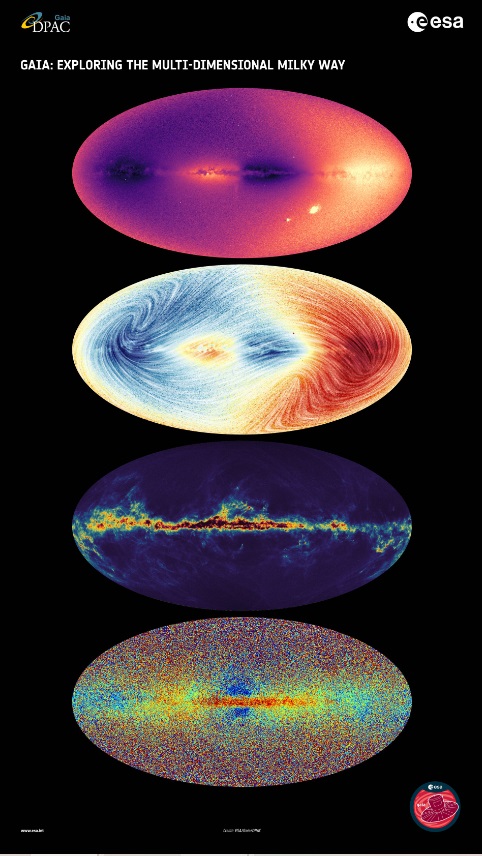
Based on this, astronomers have found that stars located closer to the center of the galaxy tend to have higher metallicity than those further away.
This says a lot about the evolution of stars in different regions: heavy metals are formed and distributed as old stars die. Therefore, they appear in the composition of new stars.
Read more:
The Japanese dumped a giant turbine into the ocean to get endless energy from the current.
Astronomers from Japan have found an unknown structure in the galaxy
Researchers filmed a 'hidden' ecosystem in an Antarctic river