Almost every galaxy has a supermassive black hole at its center. In some cases, gas falling into
Collimation is the creation of a thin parallel flow of radiation using slits through which it passes. The collimated beam is used in scintigraphy and radiation therapy.
An international team of scientists led byHiroki Okino, a graduate student at the University of Tokyo, took the highest angular resolution image to date, which shows the deepest part of the jet in a bright quasar known as 3C273.
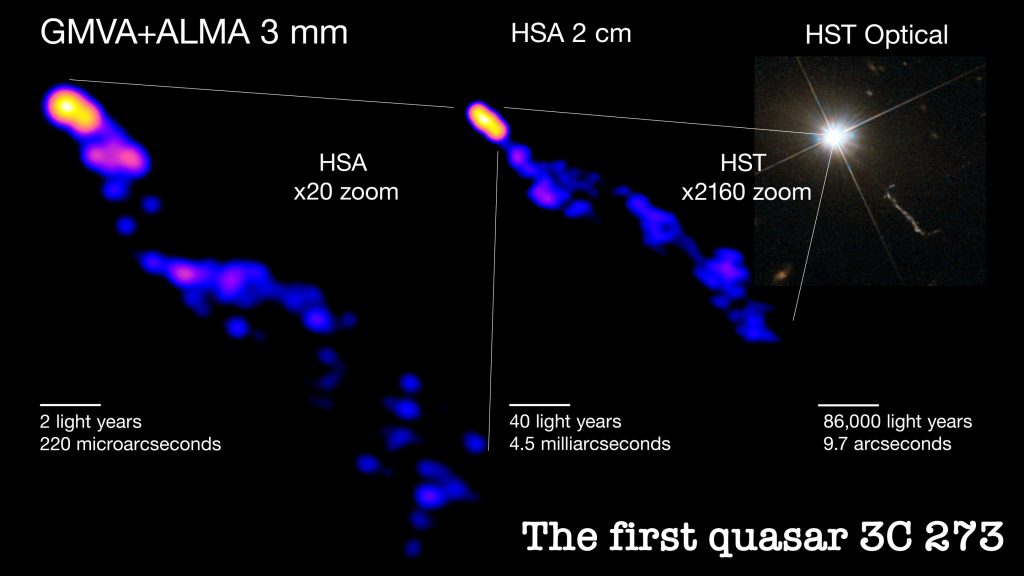 Radio astronomy images of jet 3C 273.The close-up on the left is the deepest view of the plasma jet of quasar 3C273. The image in the center shows the extended structure of the jet. The image on the right is a visible light image of a quasar taken by the Hubble Space Telescope. The radio observations were carried out by the Global Millimeter VLBI Array (GMVA), joined by the Atacama Large Millimeter/submillimeter Array (ALMA) and the High Sensitivity Array (HSA). Photo: Hiroki Okino and Kazunori Akiyama; GMVA+ALMA and HSA images: Okino et al.; HST image: ESA/Hubble and NASA
It turned out that the jet flowing from the quasarnarrows over a very long distance. This part of it extends incredibly far beyond the region where the gravity of the black hole predominates.
The results of the study showed that the structurejets are similar to those launched from nearby galaxies with low-luminosity active nuclei. This indicates that jet collimation does not depend on the level of activity in the host galaxy, which provides an important clue to the inner workings of the jets.
Read more:
A magnetic storm is about to hit Earth
Created a navigation system that is more accurate than GPS
An ancient amulet rewrote the history of Europe's most mysterious language